
6 ¶ And God said, Let there be a firmament in the midst of the waters, and let it divide the waters from the waters.
7 And God made the firmament, and divided the waters which were under the firmament from the waters which were above the firmament: and it was so.
8 And God called the firmament Heaven. And the evening and the morning were the second day.
KJV Genesis 1:6-8
As we go through the days of creation it is important to note that the events of creation were not just events. They were events that had prophetic significance. YHWH spoke the end from the beginning
9 Remember the former things of old: for I am God, and there is none else; I am God, and there is none like me,
10 Declaring the end from the beginning, and from ancient times the things that are not yet done, saying, My counsel shall stand, and I will do all my pleasure:
11 Calling a ravenous bird from the east, the man that executeth my counsel from a far country: yea, I have spoken it, I will also bring it to pass; I have purposed it, I will also do it.
KJV Isaiah 46:9-11
YHWH declaring the end from the beginning is often referred to as the Bereshit prophecy. Bereshit literally means “in the beginning” or “at the start”. According to the Bereshit prophecy that thing that had its purpose enacted in that day of creation foretells an event in the millennium that corresponds with that day. Thus, there are six full millennia for the mortal labor of man whereby he may become like Elohim, character-wise, followed by a millennium of rest during which Messiah reigns on the earth. From this, we can gather that the second day of creation points to something that happened in the second millennium of mortality.
There is a passage of scripture in the Bible that is often overlooked, or even skipped over, that shows us what the Bereshit prophecy is pointing to. It is found in Genesis chapter 5. It comprises the whole chapter in most translations and deals with the genealogy of the patriarchs. If you take all of the years between one generation of patriarchs and the next and add them together and then add the six hundred years of Noah’s life to the mix, you arrive at the flood pretty close to the middle of the second millennium. This marks a great separation of peoples. Those who obeyed Elohim were put in an ark and preserved, along with two pairs each of every unclean animal and seven pairs each of every clean animal. Those who did not repent and obey were swept away in the flood along with everything else that was not in the ark.
What was Physically Created on Day Two?
Again, we will cite Genesis 1:6-8.
6 ¶ And God said, Let there be a firmament in the midst of the waters, and let it divide the waters from the waters.
7 And God made the firmament, and divided the waters which were under the firmament from the waters which were above the firmament: and it was so.
8 And God called the firmament Heaven. And the evening and the morning were the second day.
Genesis 1:6-8
Let’s break this down at face value to get the surface level interpretation. Elohim created a firmament to divide some waters from other waters. There were waters beneath the firmament and waters above the firmament. The firmament is called heaven. There is a theory out there that goes with Flat Earth theory that says that the firmament is a solid dome. Let us investigate what the scriptures actually tell us about the firmament.
What is the Firmament?
The answer to this question is given later in the chapter.
20 And God said, Let the waters bring forth abundantly the moving creature that hath life, and fowl that may fly above the earth in the open firmament of heaven.
KJV Genesis 1:20
This gives us some new information regarding the firmament that can be readily perceived by observation. Fowls, or birds, fly in it and it is an open expanse. It is the sky above us.
Some say that it requires a solid substance to separate water from water but the children of Israel crossing the Red Sea disproves that notion.
21 And Moses stretched out his hand over the sea; and the Lord caused the sea to go back by a strong east wind all that night, and made the sea dry land, and the waters were divided.
22 And the children of Israel went into the midst of the sea upon the dry ground: and the waters were a wall unto them on their right hand, and on their left.
KJV Exodus 14:21-22
As we can see here a strong wind can divide water from water. Also, a solid dome would keep meteors from descending to earth which we see happening all of the time. Those who believe in a solid dome argue that the sun, moon, and stars were placed in that firmament as the Bible says but that would posit the birds flying amidst the stars, sun, and moon and we can observe that this is not the case.
To return to defining the firmament and refuting the solid dome hypothesis, the Bible says that the firmament is open. A hard dome is not open; however, the sky is. This also points to that which divides water from water being a constant force rather than a solid object.
It is true that the sun, moon, and stars are placed in the firmament but that indicates, given everything else, an immense expanse to the firmament rather than a simply defined solid dome over the earth. What we can infer from this is that what is happening here is the dividing away of the waters that are on earth from waters in the heavens.
This points us back to the spiritual significance of division and opposition which is symbolized in the division of the waters on the earth from the heavenly waters.
What is the Spiritual Significance of the Division of Waters?
In the second day YHWH used the firmament to divide the waters. What spiritual truth does this point to? Was this simply a utilitarian move to divide water from water, or was there deeper spiritual significance behind the action? The answer to the second question is yes on both counts. YHWH often combines actions that serve a utilitarian purpose with a deeper spiritual teaching. One example of this would be the Lamb’s blood over the door at Passover. The utilitarian purpose was to mark the households of YHWH’s people, and the deeper spiritual lesson is that YHWH’s people need to come under the blood of the Lamb (Yeshua ha Mashiach) in order to receive salvation and have their sins atoned for.
Here YHWH divides out the waters and material he will need to create the earth from other materials as a matter of practicality. Symbolically, this division of materials points to the need to discern between good and evil, necessary and unnecessary, joy and sorrow, and the other dualities of this world. This process of choosing, dividing, and defining is repeated many times. Being able to properly discern between good and evil, and subsequently, the other dualities mark the difference between YHWH’s people and the gentiles.
Whether it is necessary, good, right, or true in your mind the principle of opposition and thus duality is a part of reality. This is talked about in the Book of Mormon by Lehi as he is addressing his son Jacob.
11 For it must needs be, that there is an opposition in all things. If not so, my firstborn in the wilderness, righteousness could not be brought to pass, neither wickedness, neither holiness nor misery, neither good nor bad. Wherefore, all things must needs be a compound in one; wherefore, if it should be one body it must needs remain as dead, having no life neither death, nor corruption nor incorruption, happiness nor misery, neither sense nor insensibility.
12 Wherefore, it must needs have been created for a thing of naught; wherefore there would have been no purpose in the end of its creation. Wherefore, this thing must needs destroy the wisdom of God and his eternal purposes, and also the power, and the mercy, and the justice of God.
13 And if ye shall say there is no law, ye shall also say there is no sin. If ye shall say there is no sin, ye shall also say there is no righteousness. And if there be no righteousness there be no happiness. And if there be no righteousness nor happiness there be no punishment nor misery. And if these things are not there is no God. And if there is no God we are not, neither the earth; for there could have been no creation of things, neither to act nor to be acted upon; wherefore, all things must have vanished away.
BOM 2 Nephi 2:11-13
The presence of opposing principles ultimately points to the existence of our Elohim. Righteousness has its opposite in wickedness. Holiness, or being set apart, has its opposite in the misery that is normal Babylon life. Good has its opposite in bad. All of these things must be because they are discerned by that Elohim who created everything, even YHWH Eloheinu. He gave us his word, written by men but his word nonetheless, to aid us in discerning as he discerns.
Since one of the keys to rightly dividing is discernment it would be good to go over what discernment means.
DISCERNMENT, noun The act of discerning; also, the power or faculty of the mind, by which it distinguishes one thing from another, as truth from falsehood, virtue from vice; acuteness of judgment; power of perceiving differences of things or ideas, and their relations and tendencies. The errors of youth often proceed from the want of discernment
1828 Webster’s Dictionary
I want to bring emphasis to the fact that discernment is a faculty of the mind that allows us to distinguish between one thing and another. It is not the feeling you get in your emotional core about something or someone’s character. It is the ability to distinguish between the truth and a lie, or between good and evil, or between anything and its opposite as well as being able to perceive the degree of differentiation between things. The fall happened because of a failure to properly discern. Our power of discernment is directly related to our knowledge of Torah, both in terms of head knowledge and lived knowledge. The fall is also the first separation. The separation of man from YHWH and from the idyllic life. Throughout the early Old Testament there are tales of separations between the righteous and the wicked. You have Adam and Eve against their pre-Cain posterity.
6 And Adam was obedient to the commandments of the Lord. And after many days an angel of the Lord appeared unto Adam, saying, Wy dost thou offer sacrifices unto the Lord? And Adam said unto him, I know not, save the Lord commanded me.
7 And then the angel spake, saying, This thing is in similitude of the Only Begotten of the Father, which is full of grace and truth;
8 Wherefor, thou shalt do all that thou doest in the name of the Son. And thou shalt repent and call upon God in the name of the Son forevermore.
9 And in that day, the Holy Ghost fell upon Adam, which beareth record of the Father and the Son, saying, I am the Only Begotten of the Father from the beginning, henceforth and forever; that, as thou hast fallen, thou mayest be redeemed, and all mankind, even as many as will.
10 And in that day, Adam blessed God, and was filled, and began to prophesy concerning all the families of the earth, saying, Blessed be the name of God; for because of my transgression, my eyes are opened; and in this life I shall have joy, and again, in the flesh I shall see God.
11 And Eve, his wife, heard all these things and was glad, saying, Were it not for our transgression, we never should have had seed and never known good and evil, and the joy of our redemption, and the eternal life which God giveth to all the obedient.
12 And Aam and Eve blessed the name of God, and they made all things known unto their sons and their daughters.
13 And Satan came among them, saying, I am also a son of God. And he commanded them, saying, Believe it not. And they believed it not; and they loved Satan more than God. And men began from that time forth to be sensual and devilish.
NT Genesis 4:6-13
Then there was Cain and Abel.
4 And Adam knew Eve, his wife; and she conceived, and bare Cain, and said, I have gotten a man from the Lord; wherefore he might not reject his words. But, behold, also, Cain hearkened not, saying, Who is the Lord, that I should know him?
5 An she again conceived and are his brother Abel. And Abel hearkened unto the voice of the Lord. And Abel was a keeper of sheep, but Cain was a tiller of the ground.
6 And Cain loved Satan more than God. And Satan commanded him, saying, Make an offering uno the Lord. And in process of time, it came to pass that Cain brought of the fruit of the ground an offering unto the Lord.
7 And Abel, he also brought, of the firstlings of his flock and of the fat thereof; and the Lord had respect unto Abel and to his offering; but unto Cain and to his offering he had no respect.
NT Genesis 5:4-7
Then there was the first literal division of mankind one from another. Cain took those who would follow him and founded a new colony in the land of Nod. They were separate from Adam, Seth and those who would follow YHWH. Seth and his descendants dwelt in the land of Cainan. The Priesthood was held among them and holy books were written
4 And God revealed himself unto Seth; and he rebelled not, but offered an acceptable sacrifice like unto his brother Abel. And to him also was born a son, and he called his name Enos.
5 And then bean these men to call upon the name of the Lord; and a book of remembrance was kept in the which was recorded in the language of Adam, for it was given unto as many as called upon God to write by the Spirit of inspiration;
6 And by them their children were taught to read and write, having a language which was pure and undefiled.
7 Now this same priesthood which was in the beginning shall be in the end of the world also.
24 And they were preachers of righteousness, and spake, and prophesied, and called upon all men everywhere to repent. And faith was taught unto the children of men.
NT Genesis 6:4-7,24
All of these divisions culminate in two great divisions that spare the righteous and destroy the wicked that occur in the second Millenium. The first separation is The City of Enoch, and the second is the flood of Noah. We will go into these at length.
The City of Enoch: Zion
To paraphrase Genesis 6:9-23 in the New Translation of the Bible through Joseph Smith, Enoch is the son of Jared who is the son of Mahalaleel who is the son of Cainan who is the son of Enos who is the son of Seth who is the son of Adam. Enoch was the seventh Melchizedek high priest. He is the seventh of the patriarchs. The number seven in Hebrew numerology symbolizes completion. As we are going to discover, Enoch’s work will culminate in the completion of the work of the patriarchs, the creation of a society that was worthy to be caught up to heaven. The name of this city and society is Zion and Jerusalem was supposed to become like unto it but is far from that ideal at this time.
When Enoch was called to the work of his fathers, he was young by the standards of the patriarchs. His son, Methuselah had been born when he was 65 years old and he heard a voice from heaven commanding him to tell the people to repent. He leaves the land of Cainan and begins to preach repentance to the people testifying against the works of Cain which are among them. I find it interesting that in all of Enoch’s words against the people that repentance is referenced as a change of works. It is also interesting that the story that he chooses to share with these people is the story of Adam’s justification and subsequent redemption from the fall. He references Cainan as a land of righteousness unto this day. Who gets justified? What constitutes righteousness? Why is Enoch sent from the righteous into the midst of the wicked? Why does Elohim divide the righteous from the wicked while continuing to reach out to the wicked?
Who gets Justified ?
In order to understand who gets justified we must first understand what justification is and what must precede it. For this we will look to the story of Adam’s justification.
52 And he called upon our father Adam by his own voice, saying, I am God; I made the world and men before they were in the flesh.
53 And he also said unto him, If thou wilt, turn unto me, and hearken unto my voice, and believe, and be baptized, even in water, in the name of mine Only Begotten Son, who is full of grace and truth, which is Jesus Christ, the only name which shall be given under heaven whereby salvation shall come unto the children of men; and ye shall receive the Holy Ghost, asking all things in his name; and whatsoever ye shall ask, it shall be given you.
NT Genesis 6:52-53
What is meant by “Name”?
A very important word to correctly understand in order to understand the above scripture is the word “name.” To help us understand this meaning we will turn to the 1828 Webster’s Dictionary, because this would be the extent of Joseph Smith’s knowledge of the English language.
NAME, noun
1. That by which a thing is called; the sound or combination of sounds used to express an idea, or any material substance, quality or act; an appellation attached to a thing by customary use, by which it may be vocally distinguished from other things. A name may be attached to an individual only, and is then proper or appropriate, as John, Thomas, London, Paris; or it may be attached to a species, genus, or class of things, as sheep, goat, horse, tree, animal, which are called common names, specific or generic.
2. The letters or characters written or engraved, expressing the sounds by which a person or thing is known and distinguished.
3. A person.
They list with women each degenerate name
4. Reputation; character; that which is commonly said of a person; as a good name; a bad name
5. Renown; fame; honor; celebrity; eminence; praise; distinction.
What men of name resort to him?
6. Remembrance; memory.
The Lord shall blot out his name from under heaven. Deuteronomy 29:20.
7. Appearance only; sound only; not reality; as a friend in name Revelation 3:1.
8. Authority; behalf; part; as in the name of the people. When a man speaks or acts in the name of another, he does it by their authority or in their behalf, as their representative.
9. Assumed character of another.
Had forged a treason in my patrons name
10. In Scripture, the name of God signifies his titles, his attributes, his will or purpose, his honor and glory, his word, his grace, his wisdom, power and goodness, his worship or service, or God himself.
11. Issue; posterity that preserves the name Deuteronomy 25:6.
12. In grammar, a noun.
To call names, to apply opprobrious names; to call by reproachful appellations.
To take the name of God in vain, to swear falsely or profanely, , or to use the name of God with levity or contempt. Exodus 20:7.
To know by name to honor by a particular friendship or familiarity. Exodus 33:12.
Christian name the name a person receives by baptism, as distinguished from surname.
NAME, verb transitive to call, to name to invoke.
1. To set or give to any person or thing a sound or combination of sounds by which it may be known and distinguished ; to call; to give an appellation to.
She named the child Ichabod. 1 Samuel 4:21.
Thus was the building left Ridiculous, and the work confusion named.
2. To mention by name; to utter or pronounce the sound or sounds by which a person or thing is known and distinguished.
Neither use thyself to the naming of the Holy One.
3. To nominate; to designate for any purpose by name
Thou shalt anoint to me him whom I name to thee. I Samuel 16.
4. To entitle.
To the name of Christ, to make profession of faith in him. 2 Timothy 4:1.
1828 Webster’s Dictionary
I will refer you to definition 10 because this is what the word “name” was known to have meant when used in the Bible. Doing all things in his name isn’t about making sure that you say a name correctly before doing what you want. Doing all things in his name is about adopting his character by yielding to the enticings of the Holy Spirit which is his mind and will.
What then does it mean to believe in the name of Jesus/Yeshua? It means to believe in what he has revealed as his character through his word and by what he lived and to conform our lives to the way that he walked.
6 He that saith he abideth in him ought himself also so to walk, even as he walked.
KJV 1 John 2:6
The next thing I want to dwell on, From NT Genesis chapter 6 is the turn of phrase “if thou wilt.” This indicates that YHWH is giving Adam the choice as to whether he turns to him or not. This is absolutely key. YHWH always honors the agency of man. The success of the project of creation is not bound up in percentages of souls saved. It is not bound up in whether all those who have chosen to come to him stay faithful. If even one soul accepts the invitation to become his heir and walk in his ways and receive all that he has, the project will have been a success. We can look over the scriptural record and see the details of the lives of many who have been faithful to the end and know that this earth has already been a great success for our Elohim. In the Book of Moses in the Pearl of Great Price we can read about YHWH’s work and glory.
39 For behold, this is my work and my glory—to bring to pass the immortality and eternal life of man.
PGP Moses 1:39
From the moment that the Son was resurrected this glory had been achieved. The work still remains to be done but the Father has been glorified. He already has succeeded. The only failure, when we aren’t faithful, is our own.
Hear His Voice
The next thing to unpack from the New Translation Genesis 6 is what does it mean to hear his voice? There are marvelous promises extended to those who hear and obey his voice.
1 Verily, thus saith the Lord: It shall come to pass that every soul who forsaketh his sins and cometh unto me, and calleth on my name, and obeyeth my voice, and keepeth my commandments, shall see my face and know that I am;
Doctrine & Covenants 93:1
The children of Israel heard the voice of YHWH from the foot of Mount Sinai.
19 And when the voice of the trumpet sounded long, and waxed louder and louder, Moses spake, and God answered him by a voice.
KJV Exodus 19:19
The result was the Ten Commandments. Many people say that the children of Israel offended YHWH by their fear to approach him personally, but the scriptures don’t give that impression. In fact, from the account in Exodus , it appears that YHWH never intended to speak to all of Israel personally but rather to a select few who would carry his words to the people
20 And the Lord came down upon mount Sinai, on the top of the mount: and the Lord called Moses up to the top of the mount; and Moses went up.
21 And the Lord said unto Moses, Go down, charge the people, lest they break through unto the Lord to gaze, and many of them perish.
22 And let the priests also, which come near to the Lord, sanctify themselves, lest the Lord break forth upon them.
23 And Moses said unto the Lord, The people cannot come up to mount Sinai: for thou chargedst us, saying, Set bounds about the mount, and sanctify it.
24 And the Lord said unto him, Away, get thee down, and thou shalt come up, thou, and Aaron with thee: but let not the priests and the people break through to come up unto the Lord, lest he break forth upon them.
25 So Moses went down unto the people, and spake unto them.
KJV Exodus 19:20-25
If, prior to speaking to the mixed multitude of Israel his basic commandments, he was planning to speak to the people through Moses and the priests, then why would he have been offended when the people realized that they could not stand in his presence? This continues the established way that YHWH has put forward for giving his truth out among the people. It began with Adam who had firsthand experience with YHWH. He dispensed his knowledge freely to his children and they would choose whether to obey or to disobey. This is shown clearly in the first six chapters of Genesis as well as in Lecture on Faith 2. This is why Yeshua could say to his disciples that those who received them would receive him. It is also why Yeshua said to Joseph Smith that when his servants spoke it was the same as if he himself had spoken.
40 ¶ He that receiveth you receiveth me, and he that receiveth me receiveth him that sent me.
41 He that receiveth a prophet in the name of a prophet shall receive a prophet’s reward; and he that receiveth a righteous man in the name of a righteous man shall receive a righteous man’s reward.
42 And whosoever shall give to drink unto one of these little ones a cup of cold water only in the name of a disciple, verily I say unto you, he shall in no wise lose his reward.
KJV Matthew 10:40-42
38 What I the Lord have spoken, I have spoken, and I excuse not myself; and though the heavens and the earth pass away, my word shall not pass away, but shall all be fulfilled, whether by mine own voice or by the voice of my servants, it is the same.
Doctrine and Covenants 1:38
Some questions we all need to ask ourselves are: Have I heard the voice of YHWH? Have I heard the voice of his servants? Do I live by every word that proceeds from the mouth of Elohim, or do I look for reasons not to abide by them? Do I believe that the scriptures represent God’s voice even if they were written by his servants, or do I find reasons to discredit the foundation of our faith?
Baptism
The last thing that I want to bring forward from the New Translation Genesis Chapter 6 is baptism. Baptism in the name of Yeshua is necessary for salvation. The above reference in Genesis chapter 6 carries this principle all the way back to Adam. It has always been a part of YHWH’s plan for the redemption of his people. Baptism is the action that we take that constitutes obedience to the gospel. What is the gospel? Paul tells us what the gospel is.
1 Moreover, brethren, I declare unto you the gospel which I preached unto you, which also ye have received, and wherein ye stand;
2 By which also ye are saved, if ye keep in memory what I preached unto you, unless ye have believed in vain.
3 For I delivered unto you first of all that which I also received, how that Christ died for our sins according to the scriptures;
4 And that he was buried, and that he rose again the third day according to the scriptures:
KJV 1 Corinthians 15:1-4
Here the gospel is defined as Mashiach died for our sins, was buried, and was resurrected on the third day. How does baptism teach this? Again, Paul can instruct us in this.
1 What shall we say then? Shall we continue in sin, that grace may abound?
2 God forbid. How shall we, that are dead to sin, live any longer therein?
3 Know ye not, that so many of us as were baptized into Jesus Christ were baptized into his death?
4 Therefore we are buried with him by baptism into death: that like as Christ was raised up from the dead by the glory of the Father, even so we also should walk in newness of life.
5 For if we have been planted together in the likeness of his death, we shall be also in the likeness of his resurrection:
6 Knowing this, that our old man is crucified with him, that the body of sin might be destroyed, that henceforth we should not serve sin.
KJV Romans 6:1-6
In baptism, going under the water is being planted together with Yeshua in the likeness of his death. We are killing and burying the man of sin that we were. When we come out of the water it is symbolic of the resurrection and should accompany a spiritual rebirth. Indeed, we are born again unto good works. What are good works? They are the works of Yeshua who walked out Torah perfectly. Nephi also tells us about baptism.
6 And now, I would ask of you, my beloved brethren, wherein the Lamb of God did fulfil all righteousness in being baptized by water?
7 Know ye not that he was holy? But notwithstanding he being holy, he showeth unto the children of men that, according to the flesh he humbleth himself before the Father, and witnesseth unto the Father that he would be obedient unto him in keeping his commandments.
8 Wherefore, after he was baptized with water the Holy Ghost descended upon him in the form of a dove.
9 And again, it showeth unto the children of men the straitness of the path, and the narrowness of the gate, by which they should enter, he having set the example before them.
10 And he said unto the children of men: Follow thou me. Wherefore, my beloved brethren, can we follow Jesus save we shall be willing to keep the commandments of the Father?
11 And the Father said: Repent ye, repent ye, and be baptized in the name of my Beloved Son.
12 And also, the voice of the Son came unto me, saying: He that is baptized in my name, to him will the Father give the Holy Ghost, like unto me; wherefore, follow me, and do the things which ye have seen me do.
13 Wherefore, my beloved brethren, I know that if ye shall follow the Son, with full purpose of heart, acting no hypocrisy and no deception before God, but with real intent, repenting of your sins, witnessing unto the Father that ye are willing to take upon you the name of Christ, by baptism—yea, by following your Lord and your Savior down into the water, according to his word, behold, then shall ye receive the Holy Ghost; yea, then cometh the baptism of fire and of the Holy Ghost; and then can ye speak with the tongue of angels, and shout praises unto the Holy One of Israel.
BOM 2 Nephi 31:6=13
From this we can gather that prior to baptism we must have turned to a life of obedience to what we know to be true. We must have repented of all known sin. We cannot be deceiving ourselves and attempting to deceive our Elohim. You might ask, how do we deceive ourselves in this preparatory process? John the Beloved has an answer for you.
6 If we say that we have fellowship with him, and walk in darkness, we lie, and do not the truth:
7 But if we walk in the light, as he is in the light, we have fellowship one with another, and the blood of Jesus Christ his Son cleanseth us from all sin.
8 If we say that we have no sin, we deceive ourselves, and the truth is not in us.
9 If we confess our sins, he is faithful and just to forgive us our sins, and to cleanse us from all unrighteousness.
10 If we say that we have not sinned, we make him a liar, and his word is not in us.
KJV 1 John 1:6-10
Unless we own that we have sinned against the Torah and return to it, we are deceiving ourselves and our baptism will avail us nothing. We will go into the water a dry sinner and come out of it a wet one. Contrary to popular opinion, baptism doesn’t wash away the sins of the unrepentant. In fact, as Alma the Elder taught the repentant citizens of the wicked King Noah, baptism is a witness of the covenant we have already entered into with YHWH.
7 And it came to pass after many days there were a goodly number gathered together at the place of Mormon, to hear the words of Alma. Yea, all were gathered together that believed on his word, to hear him. And he did teach them, and did preach unto them repentance, and redemption, and faith on the Lord.
8 And it came to pass that he said unto them: Behold, here are the waters of Mormon (for thus were they called) and now, as ye are desirous to come into the fold of God, and to be called his people, and are willing to bear one another’s burdens, that they may be light;
9 Yea, and are willing to mourn with those that mourn; yea, and comfort those that stand in need of comfort, and to stand as witnesses of God at all times and in all things, and in all places that ye may be in, even until death, that ye may be redeemed of God, and be numbered with those of the first resurrection, that ye may have eternal life—
10 Now I say unto you, if this be the desire of your hearts, what have you against being baptized in the name of the Lord, as a witness before him that ye have entered into a covenant with him, that ye will serve him and keep his commandments, that he may pour out his Spirit more abundantly upon you?
Mosiah 18:7-10
Before Alma ever brought them to the waters of Mormon to be baptized, he had already taught them repentance, faith on YHWH, and redemption. In other words, he had already taught them Torah and the gospel.
What is Righteousness?
This seems like such a simple question, but its answer is profoundly revealing as to the nature, character and heart of a Zion people. There are two verses in the Pentateuch that actually define righteousness very well. First, we have Abraham.
6 And he believed in the Lord; and he counted it to him for righteousness.
KJV Genesis 15:6
In context, Abraham believed in the promises of YHWH, and this was counted to him as righteousness. Truly believing in YHWH and his promises is the foundation of righteousness. We know this by going by the hermeneutic of the first mention. This is the first time that this word is used in the scriptures. This means that all other mentions of righteousness have to be considered through this lens.
The next stop in our discovery of righteousness is with Moses in Deuteronomy.
25 And it shall be our righteousness, if we observe to do all these commandments before the Lord our God, as he hath commanded us.
KJV Deuteronomy 6:25
This equates righteousness to keeping the Torah. Modern Christianity continually wants to place a separation between belief and keeping the commandments, but when we take these two definitional statements together then we must equate them and say that one who believes in YHWH keeps his commandments.
The interesting thing about the definition of righteousness is its clear correlation to the definition of faith as given by the author of Hebrews and Alma
1 Now faith is the substance of things hoped for, the evidence of things not seen.
KJV Hebrews 11:1
21 And now as I said concerning faith—faith is not to have a perfect knowledge of things; therefore if ye have faith ye hope for things which are not seen, which are true.
BOM Alma 32:21
I really like the definition given in Hebrews. The “things hoped for” and “the things not seen” are equivalent with the promises of YHWH, especially as Abraham was looking at them in Genesis chapter 15. A lot of people don’t know what to do with the words “substance” and “evidence”. Many people want to equate warm feelings of excitement and energy as this evidence and substance, but that wouldn’t stand up as evidence in any court of law. The evidence for and substance of our belief in the promises of YHWH is our obedience to the instructions for receiving those promises.
This correlation between righteousness and faith means that righteousness is faith. This is why Paul can say that we are saved by grace through faith and also that we establish the law through faith, because actual faith presupposes obedience.
8 For by grace are ye saved through faith; and that not of yourselves: it is the gift of God:
9 Not of works, lest any man should boast.
10 For we are his workmanship, created in Christ Jesus unto good works, which God hath before ordained that we should walk in them.
KJV Ephesians 2:8-10
31 Do we then make void the law through faith? God forbid: yea, we establish the law.
KJV Romans 3:31
17 Even so faith, if it hath not works, is dead, being alone.
18 Yea, a man may say, Thou hast faith, and I have works: shew me thy faith without thy works, and I will shew thee my faith by my works.
19 Thou believest that there is one God; thou doest well: the devils also believe, and tremble.
20 But wilt thou know, O vain man, that faith without works is dead?
21 Was not Abraham our father justified by works, when he had offered Isaac his son upon the altar?
22 Seest thou how faith wrought with his works, and by works was faith made perfect?
23 And the scripture was fulfilled which saith, Abraham believed God, and it was imputed unto him for righteousness: and he was called the Friend of God.
24 Ye see then how that by works a man is justified, and not by faith only.
KJV James 2:17-24
If your definition of faith doesn’t go past mental assent, then it is not faith as defined by the Scriptures. It is dead and will not lead to your salvation. Faith causes us to follow the instructions which YHWH has given us for receiving the promises that are extended to those who believe in him and love him. This is why John the Baptist gives the following instruction to those Pharisees and scribes that came to him for baptism.
8 Bring forth therefore fruits meet for repentance:
KJV Matthew 3:8
This is even more firmly stated by Amulek in the Book of Mormon.
17 Therefore may God grant unto you, my brethren, that ye may begin to exercise your faith unto repentance, that ye begin to call upon his holy name, that he would have mercy upon you;
Alma 34:17
Faith brings repentance. Repentance brings forgiveness. Forgiveness imputes righteousness.
Enoch Sent From Among the Righteous to the Wicked
Enoch went from among his fathers in the land of Cainan and was sent to a different land to show the wisdom of YHWH to these people and to cause them to repent. He is asked about where he comes from.
42 And there came a man unto him, whose name was Mahijah, and said unto him, Tell us plainly who thou art and from whence thou comest.
43 And he said unto them, I came out of the land of Cainan, the land of my fathers, a land of righteousness unto this day; and my father taught me in all the ways of God.
NT Genesis 6:42-43
Clearly, the righteous were already being separated from the wicked. Just as clearly, the righteous are being sent forth to the wicked. Why? YHWH wants his people to share his wisdom with those who don’t have it. This is very clearly shown in Deuteronomy.
6 Keep therefore and do them; for this is your wisdom and your understanding in the sight of the nations, which shall hear all these statutes, and say, Surely this great nation is a wise and understanding people.
7 For what nation is there so great, who hath God so nigh unto them, as the Lord our God is in all things that we call upon him for?
8 And what nation is there so great, that hath statutes and judgments so righteous as all this law, which I set before you this day?
KJV Deuteronomy 4:6-8
The Israelites failed to share what they had been given with the gentiles. This is why the called-out assembly that left Egypt with Moses was mixed descendants of Israel and people of the nations.
37 ¶ And the children of Israel journeyed from Rameses to Succoth, about six hundred thousand on foot that were men, beside children.
38 And a mixed multitude went up also with them; and flocks, and herds, even very much cattle.
KJV Exodus 12:37-38
This mixed multitude created some problems on the way up to the promised land.
4 ¶ And the mixed multitude that was among them fell a lusting: and the children of Israel also wept again, and said, Who shall give us flesh to eat?
KJV Numbers 11:4
This, however, was no more or less trouble than Israel made for Moses.
3 And the children of Israel said unto them, Would to God we had died by the hand of the Lord in the land of Egypt, when we sat by the flesh pots, and when we did eat bread to the full; for ye have brought us forth into this wilderness, to kill this whole assembly with hunger.
KJV Exodus 16:3
Then you have an interesting instruction in Deuteronomy.
3 An Ammonite or Moabite shall not enter into the congregation of the Lord; even to their tenth generation shall they not enter into the congregation of the Lord for ever:
Deuteronomy 23:3
On the face of it, you could interpret this scripture in one of two ways. The first is that Moabites and Ammonites are not to be allowed to join the congregation for 10 generations. The second is that Moabites and Ammonites are not to be allowed to join the called-out assembly forever. Ruth shows us that the first interpretation is correct. She was a Moabite who was brought into the called-out assembly.
4 And they took them wives of the women of Moab; the name of the one was Orpah, and the name of the other Ruth: and they dwelled there about ten years.
KJV Ruth 1:4
16 And Ruth said, Entreat me not to leave thee, or to return from following after thee: for whither thou goest, I will go; and where thou lodgest, I will lodge: thy people shall be my people, and thy God my God:
17 Where thou diest, will I die, and there will I be buried: the Lord do so to me, and more also, if ought but death part thee and me.
18 When she saw that she was steadfastly minded to go with her, then she left speaking unto her.
19 ¶ So they two went until they came to Beth-lehem. And it came to pass, when they were come to Beth-lehem, that all the city was moved about them, and they said, Is this Naomi?
20 And she said unto them, Call me not Naomi, call me Mara: for the Almighty hath dealt very bitterly with me.
21 I went out full, and the Lord hath brought me home again empty: why then call ye me Naomi, seeing the Lord hath testified against me, and the Almighty hath afflicted me?
22 So Naomi returned, and Ruth the Moabitess, her daughter in law, with her, which returned out of the country of Moab: and they came to Beth-lehem in the beginning of barley harvest.
KJV Ruth 1:16-22
Throughout the rest of the Book of Ruth, Ruth is constantly referred to as a Moabite but treated as an Israelite under the law. She is a part of the called-out assembly, especially after she marries Boaz. She is an ancestor of Yeshua ha Mashiach.
Nevertheless, when Israel returns to the land and reads the law they choose to go with the second interpretation, expanding the prohibition to all gentiles, and thus fail in the purpose for which YHWH separated them.
1 On that day they read in the book of Moses in the audience of the people; and therein was found written, that the Ammonite and the Moabite should not come into the congregation of God for ever;
2 Because they met not the children of Israel with bread and with water, but hired Balaam against them, that he should curse them: howbeit our God turned the curse into a blessing.
3 Now it came to pass, when they had heard the law, that they separated from Israel all the mixed multitude.
KJV Nehemiah 13:1-3
Yeshua corrects this misconception with first, the great commission, and second, with Peter’s vision. The great commission is best rendered from Matthew.
19 ¶ Go ye therefore, and teach all nations, baptizing them in the name of the Father, and of the Son, and of the Holy Ghost:
20 Teaching them to observe all things whatsoever I have commanded you: and, lo, I am with you alway, even unto the end of the world. Amen.
KJV Matthew 28:19-20
He tells his disciples to teach all nations. They are to baptize the people and teach them to observe and do all of the commandments. The apostles don’t get it right away and so Peter receives a vision.
10 And he became very hungry, and would have eaten: but while they made ready, he fell into a trance,
11 And saw heaven opened, and a certain vessel descending unto him, as it had been a great sheet knit at the four corners, and let down to the earth:
12 Wherein were all manner of fourfooted beasts of the earth, and wild beasts, and creeping things, and fowls of the air.
13 And there came a voice to him, Rise, Peter; kill, and eat.
14 But Peter said, Not so, Lord; for I have never eaten any thing that is common or unclean.
15 And the voice spake unto him again the second time, What God hath cleansed, that call not thou common.
16 This was done thrice: and the vessel was received up again into heaven.
KJV Acts 10:10-16
This vision has nothing to do with declaring that which is not food becoming food. The interpretation of the vision is given to us as it comes to Peter as he is ministering to Cornelius and his household.
34 ¶ Then Peter opened his mouth, and said, Of a truth I perceive that God is no respecter of persons:
35 But in every nation he that feareth him, and worketh righteousness, is accepted with him.
36 The word which God sent unto the children of Israel, preaching peace by Jesus Christ: (he is Lord of all:)
37 That word, I say, ye know, which was published throughout all Judæa, and began from Galilee, after the baptism which John preached;
38 How God anointed Jesus of Nazareth with the Holy Ghost and with power: who went about doing good, and healing all that were oppressed of the devil; for God was with him.
39 And we are witnesses of all things which he did both in the land of the Jews, and in Jerusalem; whom they slew and hanged on a tree:
40 Him God raised up the third day, and shewed him openly;
41 Not to all the people, but unto witnesses chosen before of God, even to us, who did eat and drink with him after he rose from the dead.
42 And he commanded us to preach unto the people, and to testify that it is he which was ordained of God to be the Judge of quick and dead.
43 To him give all the prophets witness, that through his name whosoever believeth in him shall receive remission of sins.
Acts 10:34-43
Peter realizes that the gospel and the law are for all men in all nations who fear our Elohim. This reestablishes the order that was established from the beginning that Enoch is carrying out as he leaves the land of Cainan to preach to the unbelievers who are the descendants of those who followed Cain. The reason that this order exists is due to the grace of our Elohim. What does grace mean?
GRACE, noun [Latin gratia, which is formed on the Celtic; Eng. agree, congruous, and ready. The primary sense of gratus, is free, ready, quick, willing, prompt, from advancing.]
1. Favor; good will; kindness; disposition to oblige another; as a grant made as an act of grace
Or each, or all, may win a lady’s grace
2. Appropriately, the free unmerited love and favor of God, the spring and source of all the benefits men receive from him.
And if by grace then it is no more of works. Romans 11:6.
3. Favorable influence of God; divine influence or the influence of the spirit, in renewing the heart and restraining from sin.
My grace is sufficient for thee. 2 Corinthians 12:9.
4. The application of Christ’s righteousness to the sinner.
Where sin abounded, grace did much more abound. Romans 5:20.
5. A state of reconciliation to God. Romans 5:2.
6. Virtuous or religious affection or disposition, as a liberal disposition, faith, meekness, humility, patience, etc. proceeding from divine influence.
7. Spiritual instruction, improvement and edification. Ephesians 4:29.
8. Apostleship, or the qualifications of an apostle. Ephesians 3:8.
9. Eternal life; final salvation. 1 Peter 1:13.
10. Favor; mercy; pardon.
Bow and sue for grace
With suppliant knee.
11. Favor conferred.
I should therefore esteem it a great favor and grace
12. Privilege.
To few great Jupiter imparts this grace
13. That in manner, deportment or language which renders it appropriate and agreeable; suitableness; elegance with appropriate dignity. We say, a speaker delivers his address with grace; a man performs his part with grace
Grace was in all her steps.
Her purple habit sits with such a grace
On her smooth shoulders.14. Natural or acquired excellence; any endowment that recommends the possessor to others; as the graces of wit and learning.
15. Beauty; embellishment; in general, whatever adorns and recommends to favor; sometimes, a single beauty.
I pass their form and every charming grace
16. Beauty deified; among pagans, a goddess. The graces were three in number, Aglaia, Thalia, and Euphrosyne, the constant attendants of Venus.
The loves delighted, and the graces played.
17. Virtue physical; as the grace of plants. [Not used.]
18. The title of a duke or an archbishop, and formerly of the king of England, meaning your goodness or clemency. His grace the Duke of York. Your grace will please to accept my thanks.
19. A short prayer before or after meat; a blessing asked, or thanks rendered.
20. In music, graces signifies turns, trills and shakes introduced for embellishment.
Day in grace in theology, time of probation, when an offer is made to sinners.
Days in grace in commerce, the days immediately following the day when a bill or note becomes due, which days are allowed to the debtor or payor to make payment in. In Great Britain and the United States the days of grace are three, but in other countries more; the usages of merchants being different.
GRACE, verb transitive To adorn; to decorate; to embellish and dignify.
Great Jove and Phoebus graced his noble line.
And hail, ye fair, of every charm possess’d,
Who grace this rising empire of the west.
1. To dignify or raise by act of favor; to honor.
He might at his pleasure grace or disgrace whom
he would in court.
2. To favor; to honor.
3. To supply with heavenly grace
1828 Webster’s Dictionary
I would like to point out that definition number 7 highlights Torah as grace as Torah means, at its root, divine instruction on how to hit the mark.
The City of Zion Established as a Land of Righteousness
Enoch was faithful in is calling. He preached repentance and administered the baptisms in all the lands to which he was called. He led the people and they established a city. Again, we see a dividing of the waters or, symbolically speaking, peoples.
9 And it came to pass that the Lord said unto me: Look; and I looked, and I beheld the land of Sharon, and the land of Enoch, and the land of Omner, and the land of Heni, and the land of Shem, and the land of Haner, and the land of Hanannihah, and all the inhabitants thereof;
10 And the Lord said unto me: Go to this people, and say unto them—Repent, lest I come out and smite them with a curse, and they die.
11 And he gave unto me a commandment that I should baptize in the name of the Father, and of the Son, which is full of grace and truth, and of the Holy Ghost, which beareth record of the Father and the Son.
12 And it came to pass that Enoch continued to call upon all the people, save it were the people of Canaan, to repent;
13 And so great was the faith of Enoch that he led the people of God, and their enemies came to battle against them; and he spake the word of the Lord, and the earth trembled, and the mountains fled, even according to his command; and the rivers of water were turned out of their course; and the roar of the lions was heard out of the wilderness; and all nations feared greatly, so powerful was the word of Enoch, and so great was the power of the language which God had given him.
PGP Moses 7:9-13
The people who believed on Enoch’s word were led by him to establish another land of righteousness. One thing of note is that this land is not referred to as a land but as a people.
16 And from that time forth there were wars and bloodshed among them; but the Lord came and dwelt with his people, and they dwelt in righteousness.
17 The fear of the Lord was upon all nations, so great was the glory of the Lord, which was upon his people. And the Lord blessed the land, and they were blessed upon the mountains, and upon the high places, and did flourish.
18 And the Lord called his people Zion, because they were of one heart and one mind, and dwelt in righteousness; and there was no poor among them.
19 And Enoch continued his preaching in righteousness unto the people of God. And it came to pass in his days, that he built a city that was called the City of Holiness, even Zion.
PGP Moses 7:16-19
The scripture mentions that a city was built but before there was a city, there was a people. This people was divided from among the wicked and taken out from among them. The wicked had fallen into the covenant of Cain, which is combining together to turn lawlessness to gain. The righteous had to be separated from among them and a new community established so that they could walk in his ways without the influence of dark covenants and coverings. The people of Canaan were where these things were most established and so they were not preached to by Enoch. The people who were called Zion dwelt in righteousness. Their home was in faith. They trusted in the promises of YHWH and could call upon them because they were obedient to Torah. The people who were called Zion built a city called Zion. Jerusalem was meant to replicate this bastion of holiness complete with people going to the surrounding nations and bringing in new converts but that has yet to materialize and a New Jerusalem has been promised upon the North American continent in relation to the end times.
2 For behold, they rejected all the words of Ether; for he truly told them of all things, from the beginning of man; and that after the waters had receded from off the face of this land it became a choice land above all other lands, a chosen land of the Lord; wherefore the Lord would have that all men should serve him who dwell upon the face thereof;
3 And that it was the place of the New Jerusalem, which should come down out of heaven, and the holy sanctuary of the Lord.
4 Behold, Ether saw the days of Christ, and he spake concerning a New Jerusalem upon this land.
5 And he spake also concerning the house of Israel, and the Jerusalem from whence Lehi should come—after it should be destroyed it should be built up again, a holy city unto the Lord; wherefore, it could not be a new Jerusalem for it had been in a time of old; but it should be built up again, and become a holy city of the Lord; and it should be built unto the house of Israel—
6 And that a New Jerusalem should be built up upon this land, unto the remnant of the seed of Joseph, for which things there has been a type.
7 For as Joseph brought his father down into the land of Egypt, even so he died there; wherefore, the Lord brought a remnant of the seed of Joseph out of the land of Jerusalem, that he might be merciful unto the seed of Joseph that they should perish not, even as he was merciful unto the father of Joseph that he should perish not.
8 Wherefore, the remnant of the house of Joseph shall be built upon this land; and it shall be a land of their inheritance; and they shall build up a holy city unto the Lord, like unto the Jerusalem of old; and they shall no more be confounded, until the end come when the earth shall pass away.
9 And there shall be a new heaven and a new earth; and they shall be like unto the old save the old have passed away, and all things have become new.
10 And then cometh the New Jerusalem; and blessed are they who dwell therein, for it is they whose garments are white through the blood of the Lamb; and they are they who are numbered among the remnant of the seed of Joseph, who were of the house of Israel.
11 And then also cometh the Jerusalem of old; and the inhabitants thereof, blessed are they, for they have been washed in the blood of the Lamb; and they are they who were scattered and gathered in from the four quarters of the earth, and from the north countries, and are partakers of the fulfilling of the covenant which God made with their father, Abraham.
BOM Ether 13:2-11
This understanding puts a whole new light on what Yeshua said during his lifetime that his second coming would be like unto the days of Noah. The lead-up to Noah is very much like the buildup to the final apocalypse. Including the fact that a new city of righteousness must be built up along with the old one. In pre-flood times you had Zion and Cainan. At the end of this age, we will have Zion and Jerusalem. Just as Zion became an ark for the repentant before the flood, so is Zion the place prepared in the wilderness before the second coming
60 And the Lord said unto Enoch: As I live, even so will I come in the last days, in the days of wickedness and vengeance, to fulfil the oath which I have made unto you concerning the children of Noah;
61 And the day shall come that the earth shall rest, but before that day the heavens shall be darkened, and a veil of darkness shall cover the earth; and the heavens shall shake, and also the earth; and great tribulations shall be among the children of men, but my people will I preserve;
62 And righteousness will I send down out of heaven; and truth will I send forth out of the earth, to bear testimony of mine Only Begotten; his resurrection from the dead; yea, and also the resurrection of all men; and righteousness and truth will I cause to sweep the earth as with a flood, to gather out mine elect from the four quarters of the earth, unto a place which I shall prepare, an Holy City, that my people may gird up their loins, and be looking forth for the time of my coming; for there shall be my tabernacle, and it shall be called Zion, a New Jerusalem.
63 And the Lord said unto Enoch: Then shalt thou and all thy city meet them there, and we will receive them into our bosom, and they shall see us; and we will fall upon their necks, and they shall fall upon our necks, and we will kiss each other;
64 And there shall be mine abode, and it shall be Zion, which shall come forth out of all the creations which I have made; and for the space of a thousand years the earth shall rest.
PGP Moses 7:60-64
14 And to the woman were given two wings of a great eagle, that she might fly into the wilderness, into her place, where she is nourished for a time, and times, and half a time, from the face of the serpent.
15 And the serpent cast out of his mouth water as a flood after the woman, that he might cause her to be carried away of the flood.
16 And the earth helped the woman, and the earth opened her mouth, and swallowed up the flood which the dragon cast out of his mouth.
KJV Revelation 12:14-16
This was the preliminary and preparatory separation of the righteous from the wicked before the flood. In this separation it was good to be one who was taken up with Enoch. In process of time this city was taken up because of the righteousness of its people.
68 And all the days of Zion, in the days of Enoch, were three hundred and sixty-five years.
69 And Enoch and all his people walked with God, and he dwelt in the midst of Zion; and it came to pass that Zion was not, for God received it up into his own bosom; and from thence went forth the saying, Zion is Fled.
PGP Moses 7:68-69
The restoration of this city to the earth will be one of the signs of the ushering in of the 1,000-year reign of our Messiah. It was promised to Noah after he left the ark.
21 And the bow shall be in the cloud; and I will look upon it, that I may remember the everlasting covenant, which I made unto thy father Enoch; that, when men should keep all my commandments, Zion should again come on the earth, the city of Enoch which I have caught up unto myself.
22 And this is mine everlasting covenant, that when thy posterity shall embrace the truth, and look upward, then shall Zion look downward, and all the heavens shall shake with gladness, and the earth shall tremble with joy;
23 And the general assembly of the church of the firstborn shall come down out of heaven, and possess the earth, and shall have place until the end come. And this is mine everlasting covenant, which I made with thy father Enoch.
24 And the bow shall be in the cloud, and I will establish my covenant unto thee, which I have made between me and thee, for every living creature of all flesh that shall be upon the earth.
25 And God said unto Noah, This is the token of the covenant which I have established between me and thee; for all flesh that shall be upon the earth.
NT Genesis 9:21-25
The end is foretold from the beginning.
The Flood
The next great division of peoples that happened in the second millennia of the earth’s existence was the flood, and there are several points of interest in connection to this that help us understand the division as it must be between the sons of God and the sons of the Nephilim. Much has been restored that tells us who the Nephilim are.
13 And Noah and his sons hearkened unto the Lord, and gave heed, and they were called the sons of God.
14 And when these men began to multiply on the face of the earth, and daughters were born unto them, the sons of men saw that those daughters were fair, and they took them wives, even as they chose.
15 And the Lord said unto Noah: The daughters of thy sons have sold themselves; for behold mine anger is kindled against the sons of men, for they will not hearken to my voice.
PGP Moses 8:13-15
From this we learn that the Nephilim are not the gigantic descendants of human women and fallen angels. They are the sons (or followers) of men. Noah and his sons Shem, Ham, and Japheth hearkened unto YHWH and so they were called the sons (or followers) of Elohim. The Nephilim being the sons of men hearken not unto the voice of Elohim therefore His anger is kindled against them. When Noah’s granddaughters married these wicked men, they rejected the counsel of YHWH and were numbered among the Nephilim. They would be destroyed in the flood.
Now that we have looked at that little doctrinal issue let us go back to laying down the foundation of things that were similar between this division and the division that spawned the city of Enoch. Noah is called to teach the people to repent just like Enoch was.
17 And the Lord said unto Noah: My Spirit shall not always strive with man, for he shall know that all flesh shall die; yet his days shall be an hundred and twenty years; and if men do not repent, I will send in the floods upon them.
PGP Moses 8:17
19 And the Lord ordained Noah after his own order, and commanded him that he should go forth and declare his Gospel unto the children of men, even as it was given unto Enoch.
20 And it came to pass that Noah called upon the children of men that they should repent; but they hearkened not unto his words;
PGP Moses 8:19-20
From this we can see that YHWH called Noah by His (YHWH’s) own voice. He gave him (Noah) power to accomplish what He (YHWH) had called him (Noah) to do. Noah went out and fulfilled his calling. He called upon men to repent.
23 And it came to pass that Noah continued his preaching unto the people, saying: Hearken, and give heed unto my words;
24 Believe and repent of your sins and be baptized in the name of Jesus Christ, the Son of God, even as our fathers, and ye shall receive the Holy Ghost, that ye may have all things made manifest; and if ye do not this, the floods will come in upon you; nevertheless they hearkened not.
25 And it repented Noah, and his heart was pained that the Lord had made man on the earth, and it grieved him at the heart.
PGP Moses 8:23-25
In the end it was not YHWH but Noah that was sorry that YHWH had created man, and it is because of Noah’s righteous anger with the children of men that YHWH decided to remove man from the earth with the flood. This was because Noah had found grace in YHWH’s eyes.
27 And thus Noah found grace in the eyes of the Lord; for Noah was a just man, and perfect in his generation; and he walked with God, as did also his three sons, Shem, Ham, and Japheth.
PGP Moses 8:27
What is a just man? What does it mean to be perfect in one’s generation? Let’s explore the answers to these questions.
A Just Man
What is a just man? Perhaps the scripture can shed some light on this. The Hermeneutic of first mention shows that Noah was a just man. From this we can gather that a just man is very much like Noah.
9 ¶ These are the generations of Noah: Noah was a just man and perfect in his generations, and Noah walked with God.
KJV Genesis 6:9
The next time we find this word in the scriptures is far more helpful from a descriptive standpoint. While it is useful to know that Noah was a just man from the standpoint of having an example that we can look at, it is just as useful to know what defines this character trait. From the following verse in Leviticus, it can be seen that being just has everything to do with rendering righteous judgment, giving people what they pay for, and keeping the commandments that you are judging people for.
35 ¶ Ye shall do no unrighteousness in judgment, in meteyard, in weight, or in measure.
36 Just balances, just weights, a just ephah, and a just hin, shall ye have: I am the Lord your God, which brought you out of the land of Egypt.
37 Therefore shall ye observe all my statutes, and all my judgments, and do them: I am the Lord.
KJV Leviticus 19:35-37
The principle of righteous judgment is further expounded upon in Deuteronomy. In the following text it appears that rendering righteous judgment indicates that the individual rendering judgment doesn’t give undue favor or attention to wealth. They are not to take bribes in return for favorable “justice.”
18 ¶ Judges and officers shalt thou make thee in all thy gates, which the Lord thy God giveth thee, throughout thy tribes: and they shall judge the people with just judgment.
19 Thou shalt not wrest judgment; thou shalt not respect persons, neither take a gift: for a gift doth blind the eyes of the wise, and pervert the words of the righteous.
20 That which is altogether just shalt thou follow, that thou mayest live, and inherit the land which the Lord thy God giveth thee.
KJV Deuteronomy 16:18-20
Also, in Deuteronomy we see the principle of a just weight and measure is expounded upon. It is much like the justice principle of an eye for an eye. When we are determining how much one can purchase for the weight of money given, we are to use scales that weigh correctly. In other words, what is meted out should be no more or less than what has been given or taken.
13 ¶ Thou shalt not have in thy bag divers weights, a great and a small.
14 Thou shalt not have in thine house divers measures, a great and a small.
15 But thou shalt have a perfect and just weight, a perfect and just measure shalt thou have: that thy days may be lengthened in the land which the Lord thy God giveth thee.
16 For all that do such things, and all that do unrighteously, are an abomination unto the Lord thy God.
KJV Deuteronomy 25:13-16
Why is it desirable to be a just man and not a respecter of persons in judgment? This is who YHWH is.
4 He is the Rock, his work is perfect: for all his ways are judgment: a God of truth and without iniquity, just and right is he.
KJV Deuteronomy 32:4
This is a part of the character of YHWH that we are meant to assume when we take upon us the name of Yeshua. Noah was one such.
Perfect in His Generation
It is said that Noah was perfect in his generation. This is an interesting turn of phrase that almost requires that we get a Torah definition of two words: perfect and generation.
What does the word “perfect” mean according to Torah? Of course, this is another of those instances where the hermeneutic of first mention only defines perfection in the person of Noah. So, from this we get the idea that one must be like Noah in order to be perfect in their generation.
In Genesis 17 we have a recording of the first commandment to be perfect.
1 And when Abram was ninety years old and nine, the Lord appeared to Abram, and said unto him, I am the Almighty God; walk before me, and be thou perfect.
KJV Genesis 17:1
So, from this we can gather that we are commanded to be like Noah and to walk before God. Now this actually ties back to Noah and his sons in a very interesting way when we understand things that were removed from the Genesis account that have been restored. Most LDS readers will have access to these primarily through the Book of Moses in the Pearl of Great Price, but it is also in the New Translation as well. I will draw my quote from the Book of Moses for the sake of accessibility.
27 And thus Noah found grace in the eyes of the Lord; for Noah was a just man, and perfect in his generation; and he walked with God, as did also his three sons, Shem, Ham, and Japheth.
PGP Moses 8:27
From this we can see a direct parallel between the commandment to Abraham and the character attributed to Noah.
The next passage that deals with perfection and can help us understand it is from Leviticus. In this passage it is dealing with the subject of freewill offerings, offerings to solemnize vows, and peace offerings. The animal must be perfect. The rest of the passage goes into what that perfection entails. It can have no broken bones or bruises. This is because the offering represents YHWH as the party with which we are making peace or to whom we are presenting our vows. This is why they must be perfect, because he is.
17 ¶ And the Lord spake unto Moses, saying,
18 Speak unto Aaron, and to his sons, and unto all the children of Israel, and say unto them, Whatsoever he be of the house of Israel, or of the strangers in Israel, that will offer his oblation for all his vows, and for all his freewill offerings, which they will offer unto the Lord for a burnt offering;
19 Ye shall offer at your own will a male without blemish, of the beeves, of the sheep, or of the goats.
20 But whatsoever hath a blemish, that shall ye not offer: for it shall not be acceptable for you.
21 And whosoever offereth a sacrifice of peace offerings unto the Lord to accomplish his vow, or a freewill offering in beeves or sheep, it shall be perfect to be accepted; there shall be no blemish therein.
22 Blind, or broken, or maimed, or having a wen, or scurvy, or scabbed, ye shall not offer these unto the Lord, nor make an offering by fire of them upon the altar unto the Lord.
23 Either a bullock or a lamb that hath any thing superfluous or lacking in his parts, that mayest thou offer for a freewill offering; but for a vow it shall not be accepted.
24 Ye shall not offer unto the Lord that which is bruised, or crushed, or broken, or cut; neither shall ye make any offering thereof in your land.
25 Neither from a stranger’s hand shall ye offer the bread of your God of any of these; because their corruption is in them, and blemishes be in them: they shall not be accepted for you.
KJV Leviticus 22:17-25
The symbology of the offerings shows that perfection is godliness or being like our Adon (master or Lord) in character.
The next passage in which a commandment to perfection is voiced is contained in Deuteronomy. It’s place within the text is in relation to practices related to how the pagans in the land worship their gods.
9 ¶ When thou art come into the land which the Lord thy God giveth thee, thou shalt not learn to do after the abominations of those nations.
10 There shall not be found among you any one that maketh his son or his daughter to pass through the fire, or that useth divination, or an observer of times, or an enchanter, or a witch,
11 Or a charmer, or a consulter with familiar spirits, or a wizard, or a necromancer.
12 For all that do these things are an abomination unto the Lord: and because of these abominations the Lord thy God doth drive them out from before thee.
13 Thou shalt be perfect with the Lord thy God.
14 For these nations, which thou shalt possess, hearkened unto observers of times, and unto diviners: but as for thee, the Lord thy God hath not suffered thee so to do.
KJV Deuteronomy 18:9-14
It is interesting here that in this text the commandment is clearly one to covenant faithfulness to YHWH. We are to worship in the character that he has prescribed and not according to the ways of the nations round about us. Faithfulness in our allegiance to our Adon is clearly equated with perfection.
The next passage that defines perfection has to do with how we deal fairly and justly with our neighbors. We’ve seen this passage before in this blog entry.
13 ¶ Thou shalt not have in thy bag divers weights, a great and a small.
14 Thou shalt not have in thine house divers measures, a great and a small.
15 But thou shalt have a perfect and just weight, a perfect and just measure shalt thou have: that thy days may be lengthened in the land which the Lord thy God giveth thee.
16 For all that do such things, and all that do unrighteously, are an abomination unto the Lord thy God.
KJV Deuteronomy 25:13-16
At this point it should be getting pretty clear that perfection represents a pretty comprehensive character overhaul for most of us. Do we always deal fairly and justly with our neighbors? This is also a part of perfection.
As we round up our Torah definition of perfection which we can apply to the rest of scripture as a revelatory tool, we come to the crux of the matter and the true definition of perfection, which understanding should undergird our understanding of the principle of perfection throughout the rest of scripture. From this we gather that his work and his name, or character, is what is defined as perfect.
1 Give ear, O ye heavens, and I will speak; and hear, O earth, the words of my mouth.
2 My doctrine shall drop as the rain, my speech shall distil as the dew, as the small rain upon the tender herb, and as the showers upon the grass:
3 Because I will publish the name of the Lord: ascribe ye greatness unto our God.
4 He is the Rock, his work is perfect: for all his ways are judgment: a God of truth and without iniquity, just and right is he.
KJV Deuteronomy 32:1-4
How has YHWH revealed his character and work to us? Through the scriptures, which are all Torah as they are all instruction on how to hit the mark. His Torah is perfect as the Psalmist states.
7 The law of the Lord is perfect, converting the soul: the testimony of the Lord is sure, making wise the simple.
KJV Psalm 19:7
This is a primary indicator that Noah had Torah. He could not be perfect in his generation without it. Neither can we be perfect in our generation or establish Zion without it. This is why Yeshua commanded his disciples in the old world and the new to become perfect.
48 Be ye therefore perfect, even as your Father which is in heaven is perfect.
KJV Matthew 5:48
48 Therefore I would that ye should be perfect even as I, or your Father who is in heaven is perfect.
BOM 3 Nephi 12:48
We should all strive to keep YHWH’s commandments like Noah did.
Now that we have used the Torah to define perfection, we will now use it to define what this verse is referring to with “in his generation.” There are many people who relate this to the Nephilim theory advanced by Dr. Michael Heiser among others that is based on a poor translation in Genesis supplemented by the Book of Enoch. For the scholar that accepts the ongoing revelation of the mind and will of Elohim, however, you will see that it is not necessary to accept such explanations. We start with the New Translation as transmitted to us in the Book of Moses in the Pearl of Great Price. When we see the Holy Scripture restored to its original glory then our understanding of who the Nephilim are changes. They were not the hybrid children of fallen angels with human women but rather they were the children of men who married the daughters of Noah’s sons and their offspring.
13 And Noah and his sons hearkened unto the Lord, and gave heed, and they were called the sons of God.
14 And when these men began to multiply on the face of the earth, and daughters were born unto them, the sons of men saw that those daughters were fair, and they took them wives, even as they chose.
15 And the Lord said unto Noah: The daughters of thy sons have sold themselves; for behold mine anger is kindled against the sons of men, for they will not hearken to my voice.
PGP Moses 8:13-15
This frees us from any presupposition of what the phrase ‘perfect in his generations” means. This allows scripture to define it for itself.
We will again apply the hermeneutic of the first mention as we seek to define what is meant by “generations” in the word. We first find this word in Genesis in the creation account.
4 ¶ These are the generations of the heavens and of the earth when they were created, in the day that the Lord God made the earth and the heavens,
5 And every plant of the field before it was in the earth, and every herb of the field before it grew: for the Lord God had not caused it to rain upon the earth, and there was not a man to till the ground.
KJV Genesis 2:4-5
The Hebrew word translated as generations is towldoth. Towldoth is often used genealogically referring to descendants. It can also refer to order of birth and, metaphorically, can simply mean an accounting of the conception of things such as in this instance where the word is being used metaphorically to mean the account of the order of generation, conception, or creation. This is the first mention of this word in the Word and thus carries a very important place in determining the meaning of the word throughout the Word. We are to understand that this word can be understood metaphorically to mean an accounting of the creation. This can be especially helpful in understanding prophecy as it destroys the polemic of Yeshua as a false prophet.
The next time that we see this word is in a place that we would expect to see it, given that this word is often used in a genealogical context. Of interest is the fact that Adam and Eve are the first generation and the process of their generation had nothing to do with sex. This again points us to a broader understanding of this word from a biblical perspective. A generation can mean a creation.
1 This is the book of the generations of Adam. In the day that God created man, in the likeness of God made he him;
2 Male and female created he them; and blessed them, and called their name Adam, in the day when they were created.
KJV Genesis 5:1-2
Let’s continue this journey. Again, in Genesis we can read more about generations. Here we return to Noah and this phrase “perfect in his generations”. As we review this phrase in the Hebrew and within its place in the text this is stating that Noah taught his sons to keep Torah and they did.
9 ¶ These are the generations of Noah: Noah was a just man and perfect in his generations, and Noah walked with God.
10 And Noah begat three sons, Shem, Ham, and Japheth.
KJV Genesis 6:9-10
This is actually stated openly in Moses.
13 And Noah and his sons hearkened unto the Lord, and gave heed, and they were called the sons of God.
PGP Moses 8:13
And we’ll wrap up this journey in the scriptures seeking understanding of the phrase “perfect in his generation” with the verse with which YHWH commands Noah to enter the ark. He defines Noah’s perfection as being righteous among the wicked and the generation simply means those born of men currently alive. Only Noah and his household were seen righteous enough to separate from the rest of humanity and save in the ark.
1 And the Lord said unto Noah, Come thou and all thy house into the ark; for thee have I seen righteous before me in this generation.
KJV Genesis 7:1
We should all strive to be perfect in our generations as Enoch and Noah were. Such are those who will be a part of Zion, the New Jerusalem. Those who were perfect in their generation were sealed into the ark by the hand of YHWH himself, and those who were not were left to destruction in the flood, and this included the daughters of Noah’s sons who had married men of the world.
In Conclusion
It’s been a long journey, and the time has come to wrap things up and tie together the many elements of day two of the Bereshit prophecy which foretold of the building and catching up of Zion and the preservation of a righteous remnant in the ark as the rest of the world was destroyed in the flood.
Symbolically, bodies of water often stand in for people groups. In the second day of creation, we see YHWH literally use the forces of nature and an expanse to divide waters from waters. There are waters above the firmament and waters below. The waters above the firmament represent YHWH’s people, or those people who choose to believe on the Son enough to follow his example. The waters below the firmament represent those who are not YHWH’s people but are people of the world.
YHWH has always divided between his people and those who were not. The wicked divide themselves from YHWH by their choices. YHWH cut Cain off from his presence and then Cain and those who would follow him chose to dwell in a land apart from Adam and Adam’s righteous descendants.
41 And Cain was shut out from the presence of the Lord, and with his wife and many of his brethren dwelt in the land of Nod, on the east of Eden.
PGP Moses 5:41
God now has a chosen people and there are people in the world who are not living in the way that they should live if they wish to adopt YHWH’s character. A chosen people is established. This chosen people has always been Israel. This is the reason why Jacob is given the new name of Israel. The key to this lies in the meaning of Israel which is revealed to us very clearly in Genesis. The person who fits this description has power with God and man and has prevailed, through the grace (holy instruction and reconciliation) of YHWH, over the world.
28 And he said, Thy name shall be called no more Jacob, but Israel: for as a prince hast thou power with God and with men, and hast prevailed.
KJV Genesis 32:28
This has been Israel from the foundation of the world. To fulfill His promises to Abraham, Isaac, and Jacob a covenant was established with their descendants. Their descendants, however, did not honor the covenant or try to bring others into it as had been done by the righteous in other iterations of the covenant in times past. Instead, they assumed a chosen status that they didn’t bear out with their actions and then zealously protected it. They had ways for people who were not Israelites to convert but they were not actively putting the wisdom of YHWH on display for the world to see.
Enoch was called upon, by YHWH Eloheinu, to leave the righteous and preach repentance to the wicked. This shows the desire of YHWH from the beginning to reach out to the wicked and give them the chance to repent if they will.
27 And he heard a voice from heaven, saying: Enoch, my son, prophesy unto this people, and say unto them—Repent, for thus saith the Lord: I am angry with this people, and my fierce anger is kindled against them; for their hearts have waxed hard, and their ears are dull of hearing, and their eyes cannot see afar off;
28 And for these many generations, ever since the day that I created them, have they gone astray, and have denied me, and have sought their own counsels in the dark; and in their own abominations have they devised murder, and have not kept the commandments, which I gave unto their father, Adam.
29 Wherefore, they have foresworn themselves, and, by their oaths, they have brought upon themselves death; and a hell I have prepared for them, if they repent not;
30 And this is a decree, which I have sent forth in the beginning of the world, from my own mouth, from the foundation thereof, and by the mouths of my servants, thy fathers, have I decreed it, even as it shall be sent forth in the world, unto the ends thereof.
PGP Moses 6:27-30
32 And the Lord said unto Enoch: Go forth and do as I have commanded thee, and no man shall pierce thee. Open thy mouth, and it shall be filled, and I will give thee utterance, for all flesh is in my hands, and I will do as seemeth me good.
33 Say unto this people: Choose ye this day, to serve the Lord God who made you.
PGP Moses 6:32-33
The call to repent is a call to return to the service of YHWH by keeping his commandments. This call is always to be extended from Israel to the gentiles. When the gentiles heed the call they are no longer gentiles but are Israel. Room is made for them on the tree that sustains Israel. This is beautifully stated in Romans chapter 11
17 And if some of the branches be broken off, and thou, being a wild olive tree, wert grafted in among them, and with them partakest of the root and fatness of the olive tree;
18 Boast not against the branches. But if thou boast, thou bearest not the root, but the root thee.
19 Thou wilt say then, The branches were broken off, that I might be grafted in.
20 Well; because of unbelief they were broken off, and thou standest by faith. Be not highminded, but fear:
21 For if God spared not the natural branches, take heed lest he also spare not thee.
22 Behold therefore the goodness and severity of God: on them which fell, severity; but toward thee, goodness, if thou continue in his goodness: otherwise thou also shalt be cut off.
23 And they also, if they abide not still in unbelief, shall be grafted in: for God is able to graft them in again.
24 For if thou wert cut out of the olive tree which is wild by nature, and wert grafted contrary to nature into a good olive tree: how much more shall these, which be the natural branches, be grafted into their own olive tree?
25 For I would not, brethren, that ye should be ignorant of this mystery, lest ye should be wise in your own conceits; that blindness in part is happened to Israel, until the fulness of the Gentiles be come in.
26 And so all Israel shall be saved: as it is written, There shall come out of Sion the Deliverer, and shall turn away ungodliness from Jacob:
27 For this is my covenant unto them, when I shall take away their sins.
KJV Romans 11:17-27
The thing that we have to bear in mind with YHWH being unchanging is that if something is true from the time that Paul wrote it forward, it was also true from the time Paul wrote it and back. Otherwise, there is variance and changing in our Elohim. This is something that He has said doesn’t happen multiple times throughout scripture without equivocation.
10 And, Thou, Lord, in the beginning hast laid the foundation of the earth; and the heavens are the works of thine hands:
11 They shall perish; but thou remainest; and they all shall wax old as doth a garment;
12 And as a vesture shalt thou fold them up, and they shall be changed: but thou art the same, and thy years shall not fail.
KJV Hebrews 1:10-12
17 Every good gift and every perfect gift is from above, and cometh down from the Father of lights, with whom is no variableness, neither shadow of turning.
KJV James 1:17
6 For I am the Lord, I change not; therefore ye sons of Jacob are not consumed.
KJV Malachi 3:6
2 For God doth not walk in crooked paths, neither doth he turn to the right hand nor to the left, neither doth he vary from that which he hath said, therefore his paths are straight, and his course is one eternal round.
Doctrine and Covenants 3:2
1 Listen to the voice of the Lord your God, even Alpha and Omega, the beginning and the end, whose course is one eternal round, the same today as yesterday, and forever.
Doctrine and Covenants 35:1
So, Enoch is sent from Israel to the gentiles to gather out those who will repent and be grafted in to Israel. They form a new city of righteous people. This city is called Zion. Zion is protected by the power of YHWH as even the elements obey the voice of YHWH’s servant, Enoch, to protect and subsequently divide Zion from the wicked people.
13 And so great was the faith of Enoch that he led the people of God, and their enemies came to battle against them; and he spake the word of the Lord, and the earth trembled, and the mountains fled, even according to his command; and the rivers of water were turned out of their course; and the roar of the lions was heard out of the wilderness; and all nations feared greatly, so powerful was the word of Enoch, and so great was the power of the language which God had given him.
14 There also came up a land out of the depth of the sea, and so great was the fear of the enemies of the people of God, that they fled and stood afar off and went upon the land which came up out of the depth of the sea.
15 And the giants of the land, also, stood afar off; and there went forth a curse upon all people that fought against God;
16 And from that time forth there were wars and bloodshed among them; but the Lord came and dwelt with his people, and they dwelt in righteousness.
PGP Moses 7:13-16
Eventually YHWH takes the city of Zion to himself, thus permanently separating them from the consequences of mankind’s violent behavior. They become waters, or a people group, that is above the firmament, literally.
69 And Enoch and all his people walked with God, and he dwelt in the midst of Zion; and it came to pass that Zion was not, for God received it up into his own bosom; and from thence went forth the saying, Zion is Fled.
PGP Moses 7:69
A short time later, Noah is again sent to preach repentance. This time there is no repentance and Noah and His righteous sons and their wives are separated unto an ark as a righteous remnant of humanity.
19 And the Lord ordained Noah after his own order, and commanded him that he should go forth and declare his Gospel unto the children of men, even as it was given unto Enoch.
20 And it came to pass that Noah called upon the children of men that they should repent; but they hearkened not unto his words;
PGP Moses 8:19-20
23 And it came to pass that Noah continued his preaching unto the people, saying: Hearken, and give heed unto my words;
24 Believe and repent of your sins and be baptized in the name of Jesus Christ, the Son of God, even as our fathers, and ye shall receive the Holy Ghost, that ye may have all things made manifest; and if ye do not this, the floods will come in upon you; nevertheless they hearkened not.
PGP Moses 8:23-24
27 And thus Noah found grace in the eyes of the Lord; for Noah was a just man, and perfect in his generation; and he walked with God, as did also his three sons, Shem, Ham, and Japheth.
28 The earth was corrupt before God, and it was filled with violence.
29 And God looked upon the earth, and, behold, it was corrupt, for all flesh had corrupted its way upon the earth.
30 And God said unto Noah: The end of all flesh is come before me, for the earth is filled with violence, and behold I will destroy all flesh from off the earth.
PGP Moses 8:27-30
15 And they went in unto Noah into the ark, two and two of all flesh, wherein is the breath of life.
16 And they that went in, went in male and female of all flesh, as God had commanded him: and the Lord shut him in.
KJV Genesis 7:15-16
The ark was lifted up on the face of the waters and the peoples below the firmament were drowned in the flood while those riding above the waters were saved and were left to repopulate the earth.
What were the characteristics of those who were divided out and saved? They were righteous and just. They were perfect in their generation, in that they observed to keep and obey Torah as it was revealed to them. This is the kind of people that YHWH is looking for now, as we come to a time of tribulation like none that the world has ever seen. Will you be part of building Zion? Are you ready to live by every word that has proceeded, and will proceed, from the mouth of YHWH? I hope so. I hope that you will be among those whom YHWH calls into the wilderness place where the called-out assembly will be nourished for time, times and half a time. This place in the wilderness is Zion, the New Jerusalem, that will stir up the blood descendants of Israel to jealousy and will cause them to return to the fulness of YHWH Eloheinu. I live for this promise. I hope to see you there.
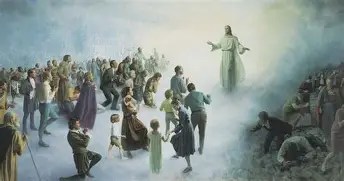
 Eternal Torah, the Mind and Will of God