2 Peter 1:16-21 is often proof texted as evidence that there is no more scripture after the New Testament Apostles. In this post we will examine these verses and we will check the validity of the New Translation / Joseph Smith Translation / Inspired Version, which for the rest of this post we will be referring to as the New Translation, rendering of verse 20. There is a difference in the rendering of verse twenty between the KJV and the New Translation. What we will explore is whether the change is justified and whether or not it makes the meaning of the passage clearer in context. Also, we will look at what this passage means in the context of the scriptures being a record of the dealings of an unchanging Elohim with the children of men. Or, in other words, we will look at this passage in light of the whole Word of God (Elohim) as opposed to looking at them through the self-preserving paradigm of Christianity. So, without further ado let’s get into the text.
Cunningly Devised Fables
16 For we have not followed cunningly devised fables, when we made known unto you the power and coming of our Lord [Adonai] Jesus Christ, but were eyewitnesses of his majesty.
There are those who are quick to write off the Book of Mormon, Doctrine & Covenants, and the New Translation as cunningly devised fables based on what they hear others say and their own inability to escape human creeds. The idea that the canonized Bible is the only word that our Elohim has given us is nothing more than Protestant Dogma. If Elohim never intended for there to be additional prophets, why send more like unto Moses? One of the things that prophets do is bring forth additional revelation that the people are then supposed to test against that which has already been revealed. The reason we can test new revelation is because YHWH’s mind and will does not change, and therefore any new revelation will not contradict that which came before but can offer continual reproof, correction, and / or deeper understanding in regard to what has already been revealed. Before we dismiss what claims to be the mind and will of YHWH revealed, we should first read it in light of what has already been revealed, testing all things to the Word, as the Bereans did.
10 ¶ And the brethren immediately sent away Paul and Silas by night unto Berea: who coming thither went into the synagogue of the Jews.
11 These were more noble than those in Thessalonica, in that they received the word with all readiness of mind, and searched the scriptures daily, whether those things were so.
It is more noble to read and test than to simply believe or disbelieve based on what we hear from others. Doing this, you gain your own understanding and practice critical thinking.
One of the pieces of evidence that Peter uses to show that what he has shared with the followers of The Way is not “cunningly devised fables” is his own eyewitness of the Son receiving glory of the Father on the Mount of Transfiguration. (We’ll be going over that later.) If, as Christians, you are willing to accept Peter’s eyewitness account as proof that the apostles were not presenting “cunningly devised fables,” your insistence that the experiences testified to by the Prophet Joseph Smith and others involved in the restoration of the 1830’s and 1840’s (including eyewitness accounts of the Father and the Son) are “cunningly devised fables” is a hypocritical double standard based on nothing more than faulty understanding of the scriptures. Nowhere in the Bible does it state that there will be no more prophets with words from YHWH.
To illustrate this point, I will bring forward a few scriptures that are often used to support the idea that there is no word beyond the Bible and examine how they are typically used, highlighting the absurdity of such interpretations.
16 All scripture is given by inspiration of God, and is profitable for doctrine, for reproof, for correction, for instruction in righteousness:
Typically, this verse is proof texted to mean that the canonized Bible is ALL that is profitable for doctrine. This private interpretation falls on its face when the verse and passage are placed in the context of the historical timeline of when this letter was written. When Paul wrote this letter to Timothy, the New Testament didn’t exist. The Gospels hadn’t even been written in Hebrew preparatorily to their translation into Greek and other languages. According to the logic of this self-serving interpretation of this passage, the New Testament should never have been compiled as the scriptures that Timothy had available to him, The Old Testament, were profitable for “reproof, correction, for instruction in righteousness.”
Wouldn’t it be better to go with what the verse actually says, and conclude that every word that proceeds from the mouth of Yah, or HIS servants, is given by inspiration or revelation from YHWH and is profitable to instruct us in the way of righteousness?
This points to the need to read and test that which claims to be scripture against the Word of YHWH that you already have, minus all religious prejudice.
Another verse that is often miscited is in Revelation.
18 For I testify unto every man that heareth the words of the prophecy of this book, If any man shall add unto these things, God shall add unto him the plagues that are written in this book:
19 And if any man shall take away from the words of the book of this prophecy, God shall take away his part out of the book of life, and out of the holy city, and from the things which are written in this book.
This is typically interpreted to mean that you cannot add to or take away from the Bible. I can see why they say that. Revelation is at the end of the Bible, right? A little bit of historical knowledge renders this interpretation problematic, however, because the gospel of John was written after John’s stay on Patmos where he received Revelations. So, was John risking the wrath of YHWH by writing his glorious gospel? Let it not be so.
Why not take the words here at face value? Let’s not add to or take away from his prophecy including not adding the whole Bible to it. To solidify this understanding, let’s look Deuteronomy 4:2.
2 Ye shall not add unto the word which I command you, neither shall ye diminish ought from it, that ye may keep the commandments of the Lord your God which I command you.
Typically, this verse is interpreted to mean that we are not to add to the word of YHWH. If this is the case, why are we reading the New Testament or anything after Deuteronomy for that measure? The typical interpretation is an understandable start. We do not want to be teaching our words as YHWH’s words. That’s one way to take YHWH’s name in vain. The typical interpretation is utterly lacking in specificity and leaves tons of room for misapplication. What this verse is literally telling us, is that we are not to add to or take away from the commandments of Torah. Yeshua reiterated how seriously he took this injunction when he repeats it from his own mouth.
17 ¶ Think not that I am come to destroy the law, or the prophets: I am not come to destroy, but to fulfil.
18 For verily I say unto you, Till heaven and earth pass, one jot or one tittle shall in no wise pass from the law, till all be fulfilled.
19 Whosoever therefore shall break one of these least commandments, and shall teach men so, he shall be called the least in the kingdom of heaven: but whosoever shall do and teach them, the same shall be called great in the kingdom of heaven.
20 For I say unto you, That except your righteousness shall exceed the righteousness of the scribes and Pharisees, ye shall in no case enter into the kingdom of heaven.
With the correct interpretation of Yeshua’s words, all of Christianity stands condemned as well as the Restoration Branches for they have taken the Torah and nailed it to a tree. To learn more about the difference between Torah and Law of Moses read Law of Moses from SeekingYHWH. Since Heaven and Earth are still here, not one jot or tittle has passed from the Torah. The additions of the Rabbis and the Kabbalists are not YHWH’s Torah. Yeshua refers to these additions as the traditions of the elders. The Rabbis call this the Oral Torah and when it was written down it became the Talmud. The creeds of dispensational Christianity are not Torah. Both of these traditions cause you to break Torah. Christianity says that you don’t have to keep it, thus removing from Torah. The Rabbis have added so many commandments to Torah that they make it stink in the eyes of most people and in Yeshua’s eyes as well.
What Deuteronomy 4:2 categorically and demonstrably does not say is that YHWH will cease to speak through prophets. This injunction against adding to the commandments is repeated later in the book of Deuteronomy as well.
32 What thing soever I command you, observe to do it: thou shalt not add thereto, nor diminish from it.
This is literally a repetition of the message in Deuteronomy chapter four. Israel is to obey anything that YHWH puts in Moses’ mouth. They are not to add to or diminish from it. He is referring specifically to what he is saying at that time.
This is another commonly miscited scripture in defense of Sola Scriptura.
1 God, who at sundry times and in divers manners spake in time past unto the fathers by the prophets,
2 Hath in these last days spoken unto us by his Son, whom he hath appointed heir of all things, by whom also he made the worlds;
The mainstream interpretation of this scripture goes as follows; God used to speak to us through prophets and has finalized his instruction to us with his Son. There is no revelation after the Son.
This interpretation presents a conundrum. The letter this passage is contained in was written after Yeshua had died and had ascended, as was the entire New Testament. Is the author of any of the books of the New Testament Yeshua? His words are contained in the gospels, but if you’re going to be consistent in your application of this interpretation then you will have to throw out Acts, all of Paul’s epistles, as well as anything not reporting to be from Yeshua himself.
Let’s look at what it actually says: YHWH has at various times spoken to our fathers through prophets. His Son, Yeshua, was just with us, giving us instruction. The Son created all things and is the heir to all things / Torah.
There is no future prohibition of further revelation of the Father and the Son voiced in this passage. There are references to events and conditions past and present but nothing pertaining to the future.
By now, I believe that I have brought forth enough evidence to prove my point. The classic Christian interpretations of these scriptures lead to problems that make the interpretations absurd, when viewed in the context of historical timelines. Whereas if we would just believe what the Word says, then we get a rational view of what these passages mean, and we get to keep these passages as inspired Word from YHWH. You will see that the same holds true for 2 Peter 1:16-21. Also, 2 Peter 1:16-21 proves (rather than disproves) the possibility of what was restored through the prophet Joseph Smith including the Book of Mormon, Doctrine & Covenants (1835 edition), and the New Translation of the Bible.
The Father Witnesses of the Son
In the next couple of verses Peter will talk about his experience on the Mount of Transfiguration.
17 For he received from God the Father honour and glory, when there came such a voice to him from the excellent glory, This is my beloved Son, in whom I am well pleased.
18 And this voice which came from heaven we heard, when we were with him in the holy mount.
The Father’s voice was heard bearing witness of the Son. This is a pattern throughout the New Testament. It is also shown as pattern for that which was restored through the prophet Joseph Smith including modern scriptures.
In Matthew chapter 3 we see the pattern that repeated at the Mount of Transfiguration.
16 And Jesus, when he [Yeshua] was baptized, went up straightway out of the water: and, lo, the heavens were opened unto him [Yeshua], and he [Yeshua] saw the Spirit of God descending like a dove, and lighting upon him [Yeshua]:
17 And lo a voice from heaven, saying, This is my beloved Son, in whom I am well pleased.
A voice is heard. No additional person is seen just as Peter states was the case on the Mount of Transfiguration. The voice bears record of the Son. Also, as on the Mount of Transfiguration, this experience was a private manifestation for Yeshua alone. The masses gathered there, and John, did not see or hear it.
In the Book of Mormon another instance of this pattern is set forth.
3 And it came to pass that while they were thus conversing one with another, they heard a voice as if it came out of heaven; and they cast their eyes round about, for they understood not the voice which they heard; and it was not a harsh voice, neither was it a loud voice; nevertheless, and notwithstanding it being a small voice it did pierce them that did hear to the center, insomuch that there was no part of their frame that it did not cause to quake; yea, it did pierce them to the very soul, and did cause their hearts to burn.
4 And it came to pass that again they heard the voice, and they understood it not.
5 And again the third time they did hear the voice, and did open their ears to hear it; and their eyes were towards the sound thereof; and they did look steadfastly towards heaven, from whence the sound came.
6 And behold, the third time they did understand the voice which they heard; and it said unto them:
7 Behold my Beloved Son, in whom I am well pleased, in whom I have glorified my name—hear ye him.
These instances of the pattern show that it can be done individually as well as to large groups. In 3 Nephi 11, the voice is heard by all gathered there. It happened this way because it was necessary that those presently gathered should have this witness that they could bring to those who were not there. Just like it was essential for Yeshua, Peter, James, and John to have that witness from the Father bearing record of the Son.
The pattern is again repeated with Joseph Smith.
17 It [light brighter than noon day] no sooner appeared than I found myself delivered from the enemy which held me bound. When the light rested upon me I saw two Personages [character assumed / outward appearance], whose brightness and glory defy all description, standing above me in the air. One of them spake unto me, calling me by name and said, pointing to the other—This is My Beloved Son. Hear Him!
Now, on face value this can seem to be pointing to a different kind of the same experience, but it isn’t. It is actually pointing to the exact same experience as talked about by Peter. The key is in understanding all of the definitions of the word personages and in understanding the relationship of the Father to the Son.
Personage
PER’SONAGE, noun A man or woman of distinction; as an illustrious personage
1. Exterior appearance; stature; air; as a tall personage; a stately personage
2. Character assumed.
The Venetians, naturally grave, love to give in to the follies of such seasons, when disguised in a false personage
3. Character represented.
Some persons must be found, already known in history, whom we may make the actors and personages of this fable.
1828 Websters Dictionary
Notice how two out of three of these definitions explicitly refer to a character assumed or represented. The first implies it. I was an actor before I developed my interest in the Word of YHWH. As an actor, I would assume different characters, all of which behaved and looked differently from me. It was still me, but I had assumed another personage. One body, two personages. This is also brought out in the Fifth Lecture on Faith.
2 There are two personages [exterior appearance] [plural] who constitute the great, matchless, governing and supreme power [singular] over all things—by whom all things were created and made, that are created and made, whether visible or invisible: whether in heaven, on earth, or in the earth, under the earth, or throughout the immensity of space—They are the Father and the Son: The Father being a personage [exterior appearance] of spirit, glory and power: possessing all perfection and fulness: The Son, who was in the bosom of the Father, a personage [exterior appearance] of tabernacle, made, or fashioned like unto man, or being in the form and likeness of man, or, rather, man was formed after his likeness, and in his image;….
5th Lecture on Faith
Again, we have the reference to two personages in one person. This is made even more clear in the Book of Mormon along with how they are related.
1 And now Abinadi said unto them: I would that ye should understand that God himself shall come down among the children of men, and shall redeem his people.
2 And because he dwelleth in flesh he shall be called the Son of God, and having subjected the flesh to the will of the Father, being the Father and the Son—
3 The Father, because he was conceived by the power of God; and the Son, because of the flesh; thus becoming the Father and Son—
4 And they are one God, yea, the very Eternal Father of heaven and of earth.
5 And thus the flesh becoming subject to the Spirit, or the Son to the Father, being one God, suffereth temptation, and yieldeth not to the temptation, but suffereth himself to be mocked, and scourged, and cast out, and disowned by his people.
The Father and the Son are two personages [roles or characters represented] within the “great, matchless, governing and supreme power” that we call God. This is why Peter, James, and John, Yeshua himself, the descendants of Lehi, and others heard the voice of the Father but only saw one person, the Son. There are multiple accounts of the first vision and in some of them Joseph Smith only recounts seeing one person as well. To say that he saw two personages is not a contradiction nor is it a sign that he can’t keep his story straight. It is a teaching of the deeper truth that there are two personages [modes / roles] that make up the great Elohim, who is but one soul. This also constitutes direct evidence that the 5th lecture on faith comes directly from his experiences as well as scripture.
From this we also see the value of the scripture that the modern-day Elijah, who is Joseph Smith, gave to us. They help to put aside false doctrine and restore the true understanding of the one Elohim of heaven and earth. As taught in the Shema, found in:
4 Hear, O Israel: The Lord [YHWH] our God [Eloheinu] is one Lord [YHWH]:
A More Sure Word of Prophecy
Peter then goes on to talk about the “more sure” word of prophecy that they have received.
19 We have also a more sure word of prophecy; whereunto ye do well that ye take heed, as unto a light that shineth in a dark place, until the day dawn, and the day star arise in your hearts:
What is this “more sure” word of prophesy of which Peter speaks? One clue comes from earlier in the chapter where Peter tells Nazarene converts to make their calling and election sure.
10 Wherefore the rather, brethren, give diligence to make your calling and election sure: for if ye do these things, ye shall never fall:
11 For so an entrance shall be ministered unto you abundantly into the everlasting kingdom of our Lord and Saviour Jesus Christ.
This is further expounded upon in more modern revelation given through the Prophet Joseph Smith, who is Elijah to our day (see Mighty and Strong One), showing that the second comforter, or “more sure word of Prophecy”, is sanctification. Not everyone who is sanctified will see Yeshua before the second coming. Not everyone who has been sanctified has seen Yeshua or YHWH on this side of mortality. That is not something that is guaranteed to everyone. To be justified is to receive the Baptism of Fire. To be sanctified is to receive the Baptism of the Holy Spirit. The Baptism of the Holy Spirit is the promise of Eternal Life that is given to those who follow the Way and walk out their faith in the Spirit (Torah) with diligence before YHWH.
2 Behold, this is pleasing unto your Lord, and the angels rejoice over you; the alms of your prayers have come up into the ears of the Lord of Sabaoth [Hosts], and are recorded in the book of the names of the sanctified, even them of the celestial world.
3 Wherefore, I now send upon you another Comforter, even upon you my friends, that it may abide in your hearts, even the Holy Spirit of promise; which other Comforter is the same that I promised unto my disciples, as is recorded in the testimony of John.
4 This Comforter is the promise which I give unto you of eternal life, even the glory of the celestial kingdom;
5 Which glory is that of the church of the Firstborn, even of God, the holiest of all, through Jesus Christ his Son—
Given that the “more sure word of prophecy” equates to having one’s calling and election made sure, and that modern revelation equates that to being sanctified, how do we go about making our calling and election sure? The clue to that lies in the rest of the verse as Peter describes what they are taking heed to. It is the light that shines in darkness. This is Yeshua and Torah as the scriptures very clearly testify.
105 Thy word is a lamp unto my feet, and a light unto my path.
23 For the commandment is a lamp; and the law is light; and reproofs of instruction are the way of life:
1 In the beginning was the Word, and the Word was with God, and the Word was God.
2 The same was in the beginning with God.
3 All things were made by him; and without him was not any thing made that was made.
4 In him was life; and the life was the light of men.
5 And the light shineth in darkness; and the darkness comprehended it not.
6 ¶ There was a man sent from God, whose name was John.
7 The same came for a witness, to bear witness of the Light, that all men through him might believe.
8 He was not that Light, but was sent to bear witness of that Light.
9 That was the true Light, which lighteth every man that cometh into the world.
JST John 1:1-9 (KJV John 1:1-9)
AA 1 In the beginning was the gospel preached through the Son.
A-BA And the gospel was the Word [Torah],
A-BB and the Word [Torah] was with the Son,
A-BA and the Son was with God [Elohim],
A-BB and the Son was of God [Elohim].
AA 2 The same was in the beginning with God [Elohim].
-BAA 3 All things were made by Him;
-BA-B and without Him
-BAA was not anything made which was made.
-BBA 4 In him was the gospel,
-BBB and the gospel was the life,
-BBC and the life was the light of men;
-BCA 5 And the light shineth
-BC-B in the world,
-BC-B and the world
-BCA perceiveth it not.
–C 6 Then was a man [John] sent from God [Elohim],
—D whose name was John.
—-EA 7 The same [John] came into the world for a witness,
—-E-B to bear witness of the Light,
—-E–C to bear record of the gospel through the Son,
—-E-B unto all,
—-EA that through him [John] men might believe.
—–FA 8 He was not that Light,
—–FB but came to bear witness of that Light.
——GA 9 Which was the true Light,
——GB which lighteth every man who cometh into the world;
see JST John 1:1-19 Chiasmus for full chiasmus
6 Jesus saith unto him, I am the way, the truth, and the life: no man cometh unto the Father, but by me.
The way, the truth, and the light are all synonymous with Torah. Yeshua here identifies himself as the Torah or mind and will of YHWH made manifest in flesh. How can Yeshua be the manifestation of YHWH’s mind and will made flesh unless he is also the manifestation of YHWH in the flesh?
16 For behold, the Spirit of Christ [Torah] is given to every man [adult], that he [adult] may know good [keep Torah] from evil [break Torah]; wherefore, I show unto you the way to judge [YHWH’s judgments]; for every thing which inviteth to do good [keep Torah], and to persuade to believe in Christ [the Messiah], is sent forth by the power and gift of Christ [Holy Spirit / Torah]; wherefore ye may know with a perfect knowledge it is of God [Elohim].
17 But whatsoever thing persuadeth men [adults] to do evil [break Torah], and [or] believe not in Christ [the Messiah], and [or] deny him [Yeshua], and [or] serve not God [Elohim], then ye may know with a perfect knowledge it is of the devil; for after this manner doth the devil work, for he [Satan] persuadeth no man [adult] to do good [keep Torah], no, not one [adult]; neither do his angels [demons]; neither do they [wicked] who subject themselves unto him [Satan].
18 And now, my brethren [righteous Saints], seeing that ye know the light [Torah] by which ye may judge [YHWH’s judgment], which light [Torah] is the light of Christ [Holy Spirit / Torah], see that ye do not judge wrongfully [contrary to Torah]; for with that same judgment which ye judge ye shall also be judged.
The Spirit of Christ is given to every adult according to these verses and it is also the light by which we should judge. As shown in the verses above, light is connected to Torah in the Old Testament. The Moroni 7:16-18 reference to Torah being given to every adult can be tied to Torah being written upon our hearts as Jeremiah said:
31 ¶ Behold, the days come, saith the Lord [YHWH], that I will make a new covenant with the house of Israel [Ephraim], and with the house of Judah:
32 Not according to the covenant that I made with their fathers in the day that I took them by the hand to bring them out of the land of Egypt; which my covenant they brake, although I was an husband unto them, saith the Lord [YHWH]:
33 But this shall be the covenant that I will make with the house of Israel [see Romans 11]; After those days, saith the Lord [YHWH], I will put my law [Torah] in their inward parts, and write it in their hearts; and will be their God [Elohim], and they shall be my people [followers].
34 And they shall teach no more every man his neighbour, and every man his brother, saying, Know the Lord [YHWH]: for they shall all know me [YHWH], from the least of them unto the greatest of them, saith the Lord [YHWH]: for I [YHWH] will forgive their iniquity, and I [YHWH] will remember [bring up] their sin no more.
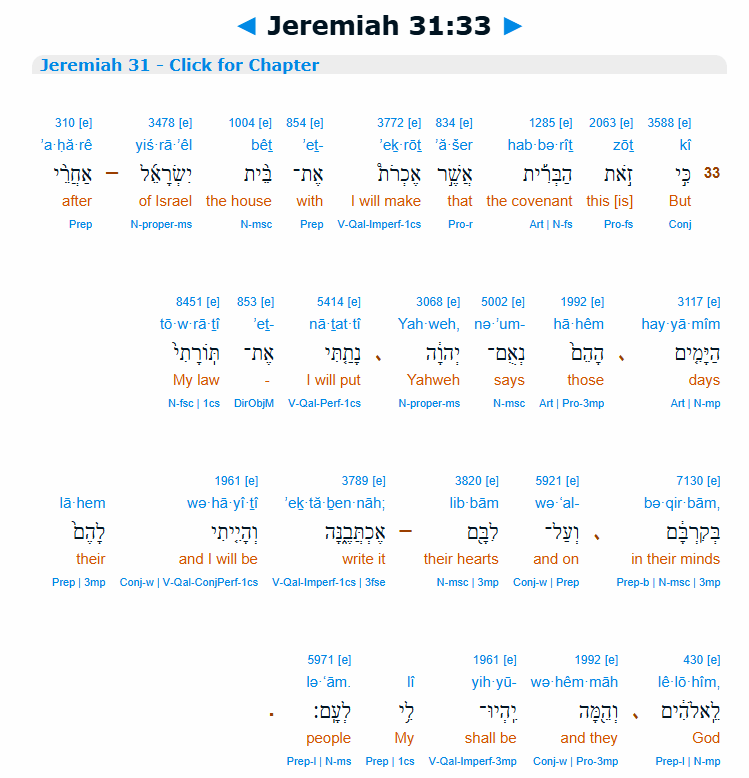
First thing of note in this passage is that the covenant is with the house of Israel and the House of Judah. It is not with some new entity called the Christian Church. The called-out assembly of Israel is continually referred to as the ecclesia in the Septuagint. If your church isn’t living by every word that has proceeded from the mouth of YHWH, they are not His people. Come out of her.
Verse 32 talks about the fault in the covenant. It was the PEOPLE. They broke the covenant and played the whore with Baal, Molech, and Ashtaroth. These are all representations of Satan in various aspects. Israel was hard hearted and would not assume the character of YHWH as revealed to them in the Torah.
As far as verse 33 goes, this isn’t actually a change to the Torah. We were always commanded to write the Torah upon our hearts. In fact, Torah is written upon the conscience of every adult. This is talking about the quality of people who will enter into the New Covenant. They love Torah. They love YHWH because he came down as Yeshua, showed them how to live Torah, taught it perfectly, and paid the blood debt for sin for all those who believe on the name and adopt the character of Yeshua. Israel is not to be understood simply as a bloodline but as those who have struggled with man and God and have prevailed. The change is in the people. The natural branches will not stay cut off if they will repent but the wild branches are being grafted into the tree that is Israel according to Romans 11 and Jacob 5.
verse 34 talks about how everyone will know YHWH. Who knows YHWH better, One who has simply seen Him or one who walks in His mind and will, fully conversant with it? The latter, though that will lead to the other eventually (though not necessarily during mortality). The point is that not every mortal will see YHWH before they die but they can still know Him if they know and walk in His mind and will. When you know what someone will do in any particular circumstance, that is when you really know them. That is what Torah does for us with YHWH. Also, until that great day when all know YHWH, teachers are necessary. Good teachers can really speed up the process of coming to know YHWH.
The “more sure” word of prophecy is sanctification, which is obtained through following Torah and the Prophets with the sacrifice of Yeshua. Yeshua is the lamb chosen before the foundation of the World. Yeshua saves us as we come under the covering of His blood. After salvation, or justification, walking in Torah, also known as the Ruach ha Qodesh, causes us to become like Yeshua. The encouragement and admonition from the prophets in the Bible and Book of Mormon gives us strength to get back up when we fall. This strength comes from hope which leads to repentance. We know we have an advocate with the Father, in the Son, if we simply repent and follow in His footsteps, Keeping Torah. All of this keeps us going onward until we are sanctified and become sons of God.
“Interpretation” or “Will of Man”?
There is an interesting difference between the KJV and the New Translation that occurs in the next verse. The KJV renders the verse as follows:
20 Knowing this first, that no prophecy of the scripture is of any private interpretation.
Many people interpret this scripture to mean that we are not to engage in our own wisdom when learning from the scriptures. What it is actually saying is that we are not to engage in private interpretation of prophecy. Given that this verse falls in a discussion of the witnesses that they have for the Word, I find the word interpretation kind of off putting, unless this is to be read as a warning regarding how we characterize our prophetic witnesses.
Also, in the New Translation it reads differently.
20 Knowing this first, that no prophecy of the scriptures is given of any private will of man.
2 Peter 1:20, New Translation
This is a difference that brings with it a sense of confidence in the source of the prophecy in the scriptures rather than a caution as to our wisdom in interpretation. I can see value to both wordings. Since detractors like to put down the New Translation I have decided to look at the Greek surrounding the difference in Bible Hub. Here is the verse broken down in an interlineal way.
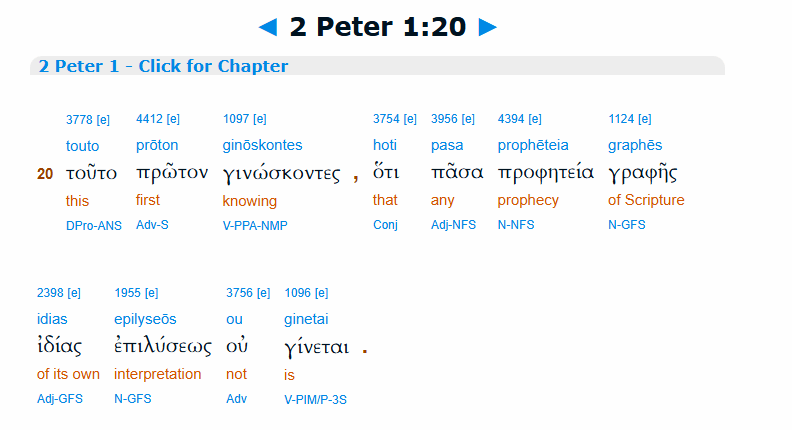
The two words that I am going to look at are G2398 and G1955. The interlinear here gives the more popular literal interpretation but let us explore to see if there are additional meanings to these words which might unlock additional insights that may have been meant to be stated all along.
idios: own, private, personal, peculiar
Original Word: ἴδιος
Part of Speech: Adjective
Transliteration: idios
Pronunciation: EE-dee-os
Phonetic Spelling: (id’-ee-os)
Definition: own, private, personal, peculiar
Meaning: one’s own, belonging to one, private, personal; one’s own people, one’s own family, home, property.
This is Strong’s G2398. Idios clearly indicates private ownership or something personal. G2398 also has close relation in meaning to G2192 in verse 19. The subject in both of these instances is mankind.
epilusis: Interpretation, explanation
Original Word: ἐπίλυσις
Part of Speech: Noun, Feminine
Transliteration: epilusis
Pronunciation: eh-PEE-loo-sis
Phonetic Spelling: (ep-il’-oo-sis)
Definition: Interpretation, explanation
Meaning: solution, explanation, interpretation; release.
Strong’s G1955 presents an interesting picture. Clearly, epilusis means interpretation. Just as clearly, it can also mean solution. When you couple the meaning of this word that communicates release with Strong’s G2398, you get private solution instead of private interpretation.
In the 1828 Webster’s dictionary we can see several interesting definitions for solution.
SOLU’TION, noun [Latin solutio, from solvo, to loosen, melt, dissolve. See Solve.]
1. The act of separating the parts of any body; disruption; breach.
2. The operation or process of dissolving or melting in a fluid; as the solution of sugar or salt. [Note. This word is not used in chimistry or mineralogy for the dissolution or melting of bodies by the heat of fire.] The term solution is appiled to a very extensive class of phenomena. When a solid disappears in a liquid, if the compound exhibits perfect transparency, we have an example of solution The word is applied both to the act of combination and to the result of the process. Thus common salt disappears in water, that is its solution takes place, and the liquid obtain ed is called a solution of salt in water. solution is the result of attraction or affinity between. the fluid and the solid. This affinity continues to operate to a certain point, where it is overbalanced bly the cohesion of the solid; it then ceases the fluid issaid to be saturated, the point where the operation ceases is called saturation, and the fluid is called a saturated solution solution is a true chimical union. Mixture is a mere mechanicall union of bodies.
3. Resolution; explanation; the act of explaning or removing difficulty or doubt; as the solution of a doubt in casuistry.
4. Release; deliverance; discharge.
5. In algebra and geometry, the answering of a question, or the resolving of a problem proposed.
SOLUTION OF CONTINUITY, the separation of connection of connected substances or parts; applied, in surgery, to a fracture, laceration, etc.
1828 Webster’s Dictionary, solution
I have bolded the definition of solution that points to the mind and will. Steven Retz showed me this definitional chain and I will show it to you. The next step is to follow definition 3 – Resolution – to its definition. If you are like Steven or I, you don’t have every definition memorized so let’s look at it.
RESOLU’TION, noun [Latin resolutio. See Resolve.]
1. The act, operation or process of separating the parts which compose a complex idea or a mixed body; the act of reducing any compound or combination to its component parts; analysis; as the resolution of complex ideas; the resolution of any material substance by chimical operations.
2. The act or process of unraveling or disentangling perplexities, or of dissipating obscurity in moral subjects; as the resolution of difficult questions in moral science.
3. Dissolution; the natural process of separating the component parts of bodies.
4. In music, the resolution of a dissonance, is the carrying of it, according to rule, into a consonance in the subsequent chord.
5. In medicine, the disappearing of any tumor without coming to suppuration; the dispersing of inflammation.
6. Fixed purpose or determination of mind; as a resolution to reform our lives; a resolution to undertake an expedition.
7. The effect of fixed purpose; firmness, steadiness or constancy in execution, implying courage.
They who governed the parliament, had the resolution to act those monstrous things.
8. Determination of a cause in a court of justice; as a judicial resolution
[But this word is now seldom used to express the decision of a judicial tribunal. We use judgment, decision or decree.]
9. The determination or decision of a legislative body, or a formal proposition offered for legislative determination. We call that a resolution which is reduced to form and offered to a legislative house for consideration, and we call it a resolution when adopted. We say, a member moved certain resolutions; the house proceeded to consider the resolutions offered; they adopted or rejected the resolutions.
10. The formal determination of any corporate body, or of any association of individuals; as the resolutions of a town or other meeting.
11. In algebra, the resolution of an equation, is the same as reduction; the bringing of the unknown quantity by itself on one side, and all the known quantities on the other, without destroying the equation, by which is found the value of the unknown quantity.
12. Relaxation; a weakening. obsolete
1828 Webster’s Dictionary, resolution
Definitions 6, 7, and 10 support solution and resolution coming from the will of man in support of the New Translation through Joseph Smith.
The New Translation is showing that the source of scriptural prophecy is YHWH, not fallible man. This tendency of man to elevate his own will to the level of prophecy is taunted by YHWH through Isaiah.
21 Produce your cause, saith the Lord; bring forth your strong reasons, saith the King of Jacob.
22 Let them bring them forth, and shew us what shall happen: let them shew the former things, what they be, that we may consider them, and know the latter end of them; or declare us things for to come.
23 Shew the things that are to come hereafter, that we may know that ye are gods: yea, do good, or do evil, that we may be dismayed, and behold it together.
24 Behold, ye are of nothing, and your work of nought: an abomination is he that chooseth you.
Man is not Elohim that he can know the end from the beginning of his own accord. Only YHWH knows the end from the beginning as shown in Isaiah 44.
7 And who, as I, shall call, and shall declare it, and set it in order for me, since I appointed the ancient people? and the things that are coming, and shall come, let them shew unto them.
8 Fear ye not, neither be afraid: have not I told thee from that time, and have declared it? ye are even my witnesses. Is there a God beside me? yea, there is no God; I know not any.
There is no Elohim like YHWH who knows the end from the beginning. For this cause, when we release our own will into prophecy the results are fallible and most likely will not come to pass. When prophecy comes from YHWH, it is sure because He knows all things.
On top of the positive evidence that we have just gone over confirming the translation of “will of man” let us examine the evidence for or against the translation of “private interpretation”.
If we go with the translation of “private interpretation” it begs the question: Interpretation of what? Interpretation is explaining not foretelling. Throughout the scriptures, prophets explain prophecy as does Yeshua and they all explain it differently, according to the context in which they are explaining them. For many examples of this idea please see 2nd Coming for how they explain things differently prophet to prophet.
If the correct translation is “private interpretation” then this would be the ONLY passage of scripture that tells us that we are not to interpret the scriptures for ourselves. The law shows us that truth is determined by the report of two or three witnesses. This passage would only be one.
15 ¶ One witness shall not rise up against a man for any iniquity, or for any sin, in any sin that he sinneth: at the mouth of two witnesses, or at the mouth of three witnesses, shall the matter be established.
1 This is the third time I am coming to you. In the mouth of two or three witnesses shall every word be established.
3 And my brother, Jacob, also has seen him as I have seen him; wherefore, I will send their words forth unto my children to prove unto them that my words are true. Wherefore, by the words of three, God hath said, I will establish my word. Nevertheless, God sendeth more witnesses, and he proveth all his words.
From these three passages we gather a scriptural and prophetic witness to the principle of truth being established by two or three witnesses.
If we go with the translation of “private interpretation” we only have 2 Peter 1:20 against the words of Yeshua to the people in the Americas commanding them to search the words of Isaiah.
1 And now, behold, I say unto you, that ye ought to search these things. Yea, a commandment I give unto you that ye search these things diligently; for great are the words of Isaiah.
2 For surely he spake as touching all things concerning my people which are of the house of Israel; therefore it must needs be that he must speak also to the Gentiles.
3 And all things that he spake have been and shall be, even according to the words which he spake.
4 Therefore give heed to my words; write the things which I have told you; and according to the time and the will of the Father they shall go forth unto the Gentiles.
5 And whosoever will hearken unto my words and repenteth and is baptized, the same shall be saved. Search the prophets, for many there be that testify of these things.
Implicit in this instruction to search the words of Isaiah is that they are to interpret them using the collective witness of the Holy Men of God who have spoken concerning these things and come to an understanding of them.
Yeshua berates the Pharisees and Sadduccees who tell the weather but do not know the signs of the times.
1 The Pharisees also with the Sadducees came, and tempting desired him that he would shew them a sign from heaven.
2 He answered and said unto them, When it is evening, ye say, It will be fair weather: for the sky is red.
3 And in the morning, It will be foul weather to day: for the sky is red and lowring. O ye hypocrites, ye can discern the face of the sky; but can ye not discern the signs of the times?
4 A wicked and adulterous generation seeketh after a sign; and there shall no sign be given unto it, but the sign of the prophet Jonas. And he left them, and departed.
Notice that they are expected to have correctly understood and interpreted prophecy.
With all of the different interpretations of prophecy put out there by “experts” one should study out prophesy and it is necessary to come to a more or less private interpretation of said prophecies with the help of YHWH. Another help in this is that many prophets have prophesied about the same thing, and you can get a collective witness which you can take to YHWH in prayer. A group of us talk about prayer in a scripture study.
Given that Yeshua has commanded us to search the prophets and expected at least the teachers of the people to be able to properly interpret them, it does not stand to reason then that Simon Peter, the chief apostle would be contradicting his master by saying that people were not to have a private interpretation, which needs to be confirmed with YHWH through prayer.
As another piece of evidence that Joseph Smith’s New translation is from the mind and will of YHWH, I present verses 20 and 21 in a Hebrew poetic form called chiasmus. Chiasmus occurs in passages of Hebrew scripture to highlight the meanings of various phrases within the passage of scripture. The center is that meaning within the passage that we are meant to focus on. Complementary stanzas help teach similar ideas and not something completely different. In the New Translation, the English breaks down easily into the chiasm which follows. “Will of Man” is actually a major hinge point in bringing out the chiasm. The poetic nature of the passage falls apart if “will of man” is replaced with “private interpretation”. BAB and BBB do not compliment each other if we take the translation of “private interpretation.”
A 20 Knowing this first,
-BAA that no prophecy of the scriptures
-BAB is given of any private will of man.
-BBA 21 For the prophecy came not
-BBB in old time by the will of man:
AA but holy men of God spake
AB as they were moved by the Holy Ghost.2 Peter 1:20-21
If there were another instance of G1955 being used anywhere in the Bible, then we could have a better understanding of which definition is more appropriate, depending on context, of course. Lacking this, we must allow the validity of either. Therefore, “private solution” is valid. The fact that the words in the New Translation are “private will of man” indicate that Joseph Smith was translating by revelation rather than by any scholastic method that we know. He moves beyond the literal translation to the intent. This intent is that we understand where these prophecies come from. This eliminates the need on our part of the reader to make the logical connection that I have drawn for you above. This shows that we can have confidence in the source of the Torah and prophets in the Bible and the Book of Mormon.
We can have confidence in the scripture affirming restoration in the New Translation as it reinforces our faith in the source of prophecy.
Moved Upon By The Holy Spirit
The Last verse of 2 Peter 1 not makes clear the source of all prophecy.
21 For the prophecy came not in old time by the will of man: but holy men of God spake as they were moved by the Holy Ghost.
Prophecy was, is, and always will be, given to us as holy men of Elohim speak as moved upon by the Ruach ha Qodesh, or Holy Spirit.
The Holy Spirit is YHWH’s mind and will.
And he being the only begotten of the Father, full of grace and truth, and having overcome, received a fulness of the glory of the Father—possessing the same mind with the Father, which mind is the Holy Spirit, that bears record of the Father and the Son, and these three are one, or in other words, these three constitute the great, matchless, governing and supreme power over all things: by whom all things were created and made, that were created and made: and these three constitute the Godhead, and are one: The Father and the Son possessing the same mind, the same wisdom, glory, power and fulness: Filling all in all—the Son being filled with the fulness of the Mind, glory and power, or, in other words, the Spirit, glory and power of the Father—possessing all knowledge and glory, and the same kingdom: sitting at the right hand of power, in the express image and likeness of the Father—a Mediator for man—being filled with the fulness of the Mind of the Father, or, in other words, the Spirit of the Father: which Spirit is shed forth upon all who believe on his name and keep his commandments: and all those who keep his commandments shall grow up from grace to grace, and become heirs of the heavenly kingdom, and joint heirs with Jesus Christ; possessing the same mind, being transformed into the same image or likeness, even the express image of him who fills all in all: being filled with the fulness of his glory, and become one in him, even as the Father, Son and Holy Spirit are one.
Lecture on Faith 5
The revelation of the mind and will of YHWH available to all men is found in the Holy Scriptures, but they must be understood within the mind of YHWH. YHWH has revealed His character to us in Torah. The first part of understanding prophecy is finding someone who is filled with the Spirit of Prophecy to explain it.
4 Wherefore, hearken, O my people, which are of the house of Israel, and give ear unto my words; for because the words of Isaiah are not plain unto you, nevertheless they are plain unto all those that are filled with the spirit of prophecy. But I give unto you a prophecy, according to the spirit which is in me; wherefore I shall prophesy according to the plainness which hath been with me from the time that I came out from Jerusalem with my father; for behold, my soul delighteth in plainness unto my people, that they may learn.
The same Spirit that gives prophecy gave Torah with all of the marvelous prophecies that are contained within it. All of scripture must be looked at in a light that makes all other scripture true and relevant because YHWH’s ways remain the same from all eternity to all eternity and he is no respecter of persons.
Conclusion
In conclusion, I have discovered that this passage of scripture does not invalidate Joseph Smith, The Book of Mormon, or the New Translation. Rather, it validates them time and again. From the eyewitness testimonies as proof that these are not cunningly devised fables to the validation of the difference in wording between the KJV and New Translation, this passage delivers again and again in favor of Joseph Smith being the modern-day Elijah sent to turn the hearts of the children to the promises made to the fathers.
1 Behold, I will reveal unto you the Priesthood, by the hand of Elijah the prophet, before the coming of the great and dreadful day of the Lord.
2 And he shall plant in the hearts of the children the promises made to the fathers, and the hearts of the children shall turn to their fathers.
3 If it were not so, the whole earth would be utterly wasted at his coming.
4 ¶ Remember ye the law of Moses my servant, which I commanded unto him in Horeb for all Israel, with the statutes and judgments.
5 ¶ Behold, I will send you Elijah the prophet before the coming of the great and dreadful day of the Lord:
6 And he shall turn the heart of the fathers to the children, and the heart of the children to their fathers, lest I come and smite the earth with a curse.
According to Malachi the promises made to the fathers are equated to Torah which is the revealed mind and will of Elohim, in other words the revelation of His Holy Spirit. Joseph Smith started the restitution of all things. All things is Torah. We must walk in YHWH’s mind and will (or Holy Spirit) which is revealed in Torah (all scripture that is not defining a specific bounded punishment). As we do so we will come to understand prophecy better and we will be better able to call repentance and help others to walk in the light of Torah. As this happens, we will come to that day where all will know YHWH who have chosen to become His people.
 Eternal Torah, the Mind and Will of God
2 responses to “No Prophecy of Scripture”
Good post bringing out the kingdom of heaven and why we need the New Translation known as JST or Inspired Version.
LikeLike
Thank you.
LikeLiked by 1 person